Get in touch
Thank you for reaching out! Please tell us more about your needs — our expert team will get back to you within 24 hours.
Get in touch
Thank you for reaching out! Please tell us more about your needs — our expert team will get back to you within 24 hours.
Summary: ASTM E84 is a North American test method for measuring the surface burning characteristics of building materials. It is commonly known as the Steiner Tunnel Test. The test reports two key results: Flame Spread Index and Smoke Developed Index.
ASTM E84 is mainly used for interior wall and ceiling finishes, including wall panels, ceiling panels, acoustic panels, insulation products, decorative laminates, coatings, textile wall coverings, vinyl wall coverings, and some fabric-wrapped surfaces. It is not a general “fabric flammability certificate,” and it should not be confused with NFPA 701 for curtains, EN 13501-1 for European reaction to fire classification, furniture fire tests, apparel flammability tests, or fire resistance ratings.
For flame retardant textile buyers, ASTM E84 matters most when the fabric becomes part of an interior finish system, such as a wall covering, ceiling covering, acoustic panel, or fabric-wrapped architectural surface.

ASTM E84 is a standard test method for evaluating the surface burning characteristics of building materials. It measures how flame spreads across the surface of a material under controlled tunnel test conditions.
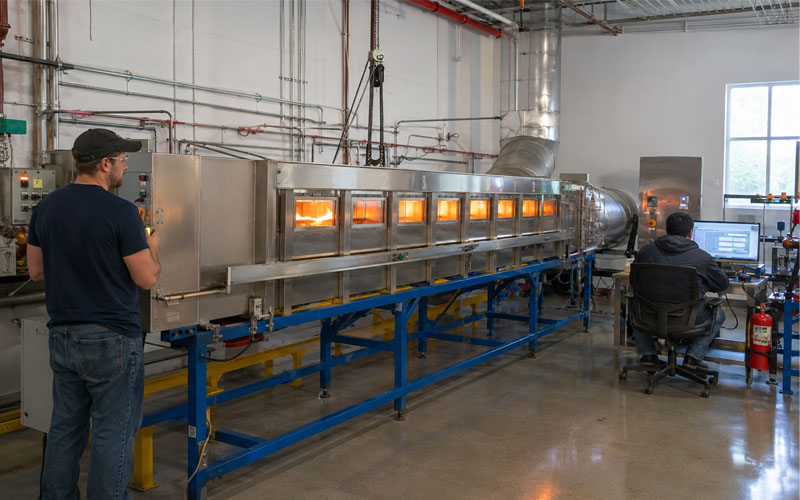
The full name is ASTM E84, Standard Test Method for Surface Burning Characteristics of Building Materials. It is also widely called the Steiner Tunnel Test because the test is performed in a long horizontal tunnel furnace.
The purpose of ASTM E84 is comparison and classification. It helps code officials, architects, contractors, and material buyers compare how different materials behave when flame travels along their exposed surface.
ASTM E84 is a surface burning test. It is not a fireproof test, not a fire resistance test, and not a universal approval for every textile application.
This distinction is important. A material can receive a Class A rating under ASTM E84 and still be combustible. Class A means the material has a low flame spread index under this test method. It does not mean the material is non-combustible or able to resist fire for 1 hour, 2 hours, or any other time period.
ASTM E84 is mainly used in the United States and North American code systems for interior wall and ceiling finish classification. It is commonly referenced in building specifications, fire code documents, commercial interior projects, and material approval packages.
In the United States, ASTM E84 is often connected with interior finish requirements in building and fire codes. UL 723 is also commonly referenced for a similar surface burning purpose. In Canada, CAN/ULC-S102 is often used for similar types of evaluation, but it is not automatically the same as ASTM E84. In Europe, the main reaction to fire classification system is EN 13501-1, not ASTM E84.
| Region | Common Standard System | ASTM E84 Relevance | Buyer Note |
|---|---|---|---|
| United States | ASTM E84, UL 723, IBC, IFC, NFPA-related code systems | Very common | Often used for Class A, Class B, and Class C interior finish classification |
| Canada | CAN/ULC-S102 | Related purpose, but not identical | Do not replace a Canadian requirement with ASTM E84 unless the project accepts it |
| Europe | EN 13501-1 | Usually not the main system | European projects normally require Euroclass ratings instead of ASTM Class A, B, or C |
| Middle East and Asia | Project specification dependent | Common in U.S.-based specifications | International hotels, offices, and public buildings may request ASTM E84 if the design specification follows U.S. standards |
Global buyers should always follow the standard written in the project specification. If a document asks for ASTM E84 Class A, an EN 13501-1 report may not be enough. If a document asks for EN 13501-1, an ASTM E84 Class A report should not be treated as an automatic substitute.
ASTM E84 is used for materials installed as building surfaces, especially interior wall and ceiling finishes. The tested material is usually evaluated as a surface that may be exposed to flame in a building interior.
ASTM E84 is not limited to textiles. It is used across many building product categories. This is why the standard appears in specifications for architectural panels, insulation, wall systems, ceiling materials, decorative surfaces, and some textile-based finishes.
| Material Type | Typical Use | Why ASTM E84 May Be Requested |
|---|---|---|
| Wall panels | Commercial wall finish | They form part of the exposed interior surface |
| Ceiling panels | Interior ceiling finish | Ceiling surfaces are commonly regulated by flame spread classification |
| Textile wall coverings | Fabric-based decorative wall surfaces | The textile acts as an interior finish, not as a loose fabric |
| Vinyl wall coverings | Commercial wall decoration | Surface burning and smoke behavior affect code review |
| Acoustic panels | Offices, studios, schools, halls, public interiors | They are often installed on walls or ceilings as exposed surfaces |
| Decorative laminates | Wall, ceiling, and furniture-adjacent surfaces | Surface flame spread may be part of the building specification |
| Insulation boards | Building envelope or interior assemblies | Many insulation products require surface burning classification |
| Coatings and composite boards | Architectural and technical surfaces | Coating, substrate, and exposed surface can affect flame spread |
For textile buyers, the most relevant category is not ordinary apparel fabric or loose curtain fabric. It is textile material used as a wall covering, ceiling covering, panel surface, or architectural interior finish. This is where flame retardant fabric may enter an ASTM E84 discussion.
ASTM E84 does not test every type of fire performance. It should not be used as a universal flame retardant certificate for fabrics, furniture, curtains, bedding, protective clothing, or full building assemblies.
The test focuses on flame spread and smoke development along a material surface. It does not measure heat insulation, structural fire resistance, flash fire protection, molten metal protection, wash durability, or full-room fire behavior.
Flame spread rating is not the same as fire resistance rating. ASTM E84 measures how flame spreads across a surface. Fire resistance ratings measure how long a building element or assembly can resist fire exposure while maintaining defined performance. These are different concepts.
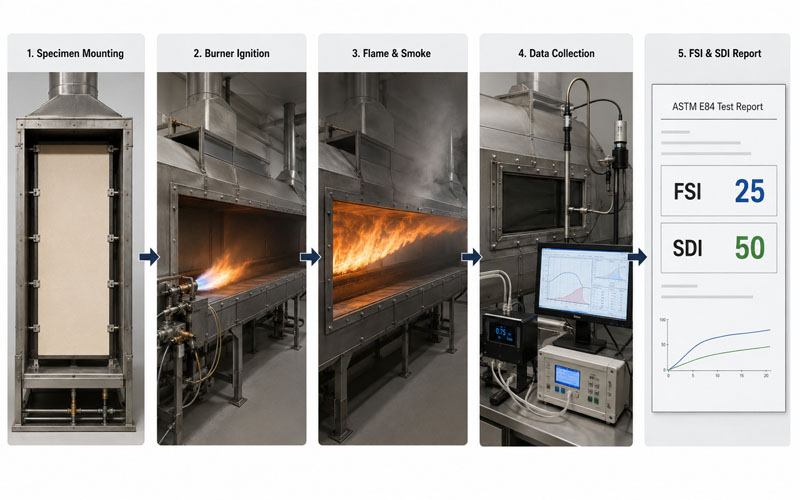
ASTM E84 is performed in a horizontal Steiner tunnel, where a long specimen is exposed to a controlled flame and airflow for 10 minutes. The test observes how far and how fast flame moves along the specimen surface and how much smoke is developed.
The specimen is usually mounted on the top side of the tunnel. A gas flame is applied at one end, and controlled airflow moves through the tunnel. During the test, the flame front is observed as it travels along the specimen. Smoke is measured through an optical system.
The test result is comparative. The index values are based on comparison with reference materials. This is why the result is called an index, not a direct measurement such as temperature, time to failure, or heat release rate.

ASTM E84 results are reported as Flame Spread Index and Smoke Developed Index. These two values describe different parts of surface burning behavior.
Flame Spread Index is often abbreviated as FSI. It indicates how flame spread over the tested surface compared with reference materials. Smoke Developed Index is often abbreviated as SDI. It indicates the relative smoke produced during the test.
| Report Item | Meaning | How to Read It |
|---|---|---|
| Flame Spread Index | Relative flame spread across the tested surface | Lower values generally indicate lower surface flame spread under the test conditions |
| Smoke Developed Index | Relative smoke generated during the test | Lower values generally indicate less smoke under the test conditions |
| Classification | Class A, Class B, or Class C | Used for interior finish classification in many specifications |
| Specimen description | What exact material was tested | Must match the product, backing, thickness, and mounting method used in the project |
A good ASTM E84 review should not stop at the word “passed.” Buyers, contractors, and specifiers should check the actual FSI and SDI values, the material description, the mounting method, and any limitations stated in the report.
ASTM E84 Class A, Class B, and Class C ratings classify materials mainly by Flame Spread Index, with Smoke Developed Index commonly limited to 450. Class A is the highest common surface burning classification in this system.
These ratings are widely used for interior wall and ceiling finishes. They help code officials and project teams decide whether a material can be used in certain building areas.
| Class | Flame Spread Index | Smoke Developed Index | Common Meaning |
|---|---|---|---|
| Class A | 0-25 | 0-450 | Highest common surface burning classification |
| Class B | 26-75 | 0-450 | Medium surface burning classification |
| Class C | 76-200 | 0-450 | Lower surface burning classification |
Class A does not mean non-combustible. It means the material achieved a low Flame Spread Index within the ASTM E84 classification range. Some Class A products can still burn, melt, char, drip, or produce smoke depending on their composition and the fire condition.
Textile wall coverings may need ASTM E84 when they are used as interior wall or ceiling finish materials. This is one of the most important ways ASTM E84 connects with fabrics.
A textile wall covering is not treated the same as a loose piece of fabric. Once the textile is adhered to a wall, backed with another material, installed over a substrate, or used as a decorative interior finish, its fire behavior can depend on the entire surface system.
For textile wall coverings, the tested construction may include the fabric face, backing, adhesive, substrate, thickness, and installation method. A fabric-only report may not always represent the installed wall covering system.
This is why textile wall covering buyers should avoid asking only “Does the fabric pass ASTM E84?” A better question is: “Was the same wall covering construction tested in the way it will be installed?”
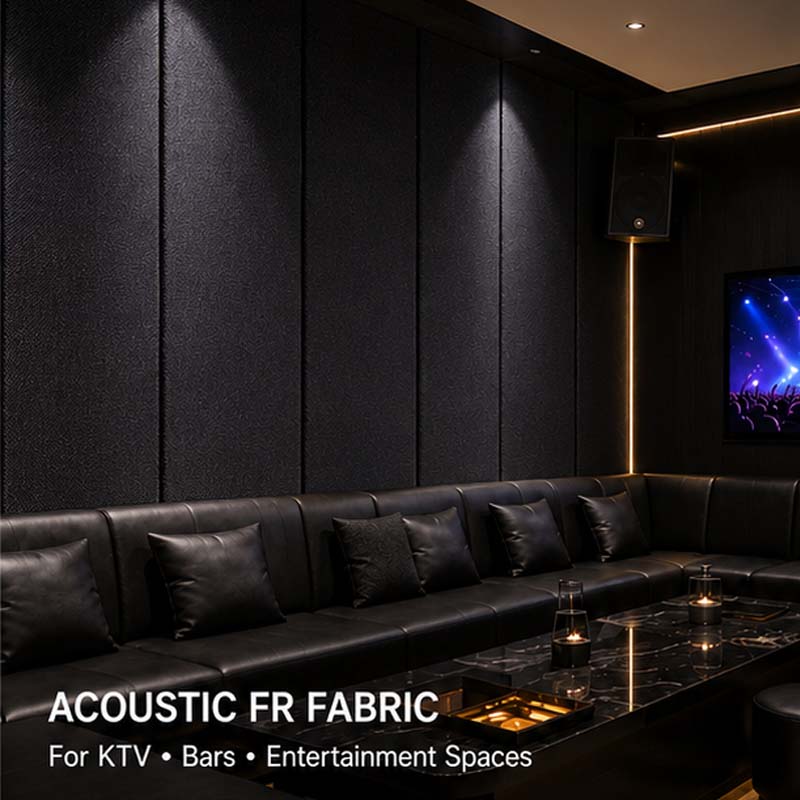
Acoustic panels often use ASTM E84 because they are installed on walls or ceilings as interior finish systems. In this application, the fabric is only one part of the tested surface.
An acoustic panel may include face fabric, acoustic core, fiberglass board, mineral wool, foam, frame, adhesive, scrim, backing, and mounting hardware. Each layer can influence the burning behavior of the final panel.
For this reason, a flame retardant acoustic fabric report may be useful, but it may not be enough for every project. Some specifications require the panel system or representative assembly to be tested, not just the fabric.
| Acoustic Product | What May Need Review | ASTM E84 Concern |
|---|---|---|
| Fabric-wrapped wall panel | Face fabric, core, adhesive, backing, mounting | The final panel may perform differently from the fabric alone |
| Ceiling acoustic panel | Panel core, surface fabric, suspension or fixing method | Ceiling finish requirements may be stricter in some spaces |
| Direct-glue acoustic fabric | Fabric, adhesive, wall substrate | Adhesive and substrate may affect flame spread and smoke |
| Decorative acoustic wall system | Full surface system | Project may require Class A surface burning classification |
Flame retardant acoustic materials are common in offices, cinemas, conference rooms, schools, studios, hotels, and public halls. Buyers can review related acoustic textile concepts through flame retardant acoustic fabrics, but the ASTM E84 report should always match the specific installation requirement.

ASTM E84, UL 723, NFPA 255, and CAN/ULC-S102 are related surface burning tests, but buyers should not assume they are always interchangeable. The standard named in the project specification should be followed.
ASTM E84 is the ASTM test method. UL 723 is a UL standard often used for surface burning characteristics. NFPA 255 is a historically referenced related method. CAN/ULC-S102 is commonly used in Canada for surface burning characteristics of building materials.
| Standard | Common Region | Main Purpose | Buyer Note |
|---|---|---|---|
| ASTM E84 | United States | Surface burning characteristics of building materials | Common basis for Class A, B, and C interior finish classification |
| UL 723 | United States | Surface burning characteristics | Often appears together with ASTM E84 in specifications |
| NFPA 255 | United States | Surface burning characteristics | May appear in older or legacy documents |
| CAN/ULC-S102 | Canada | Surface burning characteristics of building materials | Similar purpose, but Canadian projects may specifically require this standard |
If the specification says ASTM E84, provide ASTM E84. If it says UL 723, provide UL 723. If it says CAN/ULC-S102, do not assume that a U.S. report will automatically satisfy the Canadian requirement.
ASTM E84 is for surface burning characteristics of building materials, while NFPA 701 is for flame propagation of hanging textiles and films. The two standards are often confused because both may involve flame retardant textiles.
Use the final application to choose the correct standard. A curtain hanging freely in a room is not the same as a fabric adhered to a wall. A textile wall covering is not the same as a stage drape. The fire exposure and installation condition are different.
| Question | ASTM E84 | NFPA 701 |
|---|---|---|
| What does it mainly test? | Surface burning characteristics of building materials | Flame propagation of textiles and films |
| Common textile-related use | Textile wall coverings, acoustic panels, ceiling textile surfaces | Curtains, draperies, stage fabrics, hanging decorations |
| Typical result style | FSI, SDI, and Class A/B/C classification | Pass or fail based on flame propagation criteria |
| Main mistake | Using a fabric-only surface report for every installed system | Using a curtain test to approve a wall or ceiling finish |
If the product is a curtain, drapery, or hanging fabric, review NFPA 701 first. If the product is a wall covering, acoustic panel, or ceiling finish, ASTM E84 may be more relevant.
ASTM E84 is a North American flame spread classification method, while EN 13501-1 is the European reaction to fire classification system. They are not simple one-to-one equivalents.
ASTM E84 reports Flame Spread Index, Smoke Developed Index, and Class A, B, or C. EN 13501-1 uses Euroclass ratings such as A1, A2, B, C, D, E, and F, often with additional smoke and flaming droplet classifications such as s1, s2, s3 and d0, d1, d2.
This means ASTM E84 Class A should not be automatically converted into EN 13501-1 Class B or A2. The test methods, classification logic, and regulatory systems are different.
| Item | ASTM E84 | EN 13501-1 |
|---|---|---|
| Main market | United States and North American specifications | Europe and Euroclass-based specifications |
| Result format | FSI, SDI, Class A/B/C | A1, A2, B, C, D, E, F with smoke and droplet classification |
| Common use | Interior wall and ceiling finish classification | Reaction to fire classification for construction products |
| Can it be directly converted? | No | No |
For European projects, buyers should review EN 13501-1 textile fire ratings and confirm the exact Euroclass required. For global projects, a broader textile standards review is often necessary.
The biggest misunderstanding is treating ASTM E84 as a general flame retardant certificate for all fabrics. ASTM E84 is important, but only within its correct scope.
These misunderstandings can lead to wrong material approval, failed inspection, delayed installation, or costly re-testing. The safest approach is to match the test report to the final application and the exact standard named in the project document.
ASTM E84 is a surface burning test for building materials and interior finish materials. It is commonly known as the Steiner Tunnel Test and is mainly used in North American specifications.
The test reports Flame Spread Index and Smoke Developed Index. These values are used to classify materials as Class A, Class B, or Class C. Class A is the highest common classification, but it does not mean non-combustible and does not mean fire resistance for a specific number of minutes.
ASTM E84 is most relevant to wall and ceiling finishes, textile wall coverings, acoustic panels, decorative panels, insulation, laminates, coatings, and fabric-wrapped architectural surfaces. It is not a replacement for NFPA 701, EN 13501-1, furniture standards, apparel standards, bedding standards, or PPE standards.
For textile applications, ASTM E84 should be considered when the fabric becomes part of an interior finish system. The test report should be checked carefully for the exact material, backing, adhesive, substrate, mounting method, FSI, SDI, classification, and limitations.
ASTM E84 is mainly used in the United States and North American specifications. It may also appear in international hotel, office, airport, retail, and public building projects when the design specification follows U.S. fire code practice.
No. ASTM E84 is not a textile-only standard. It is a surface burning test for building materials. Fabrics are usually connected with ASTM E84 only when they are used as textile wall coverings, ceiling coverings, acoustic panels, or fabric-wrapped interior surfaces.
What does ASTM E84 Class A mean?
ASTM E84 Class A usually means the material has a Flame Spread Index of 0-25 and a Smoke Developed Index of 0-450. It is the highest common surface burning classification, but it does not mean the material is non-combustible.
No. ASTM E84 and NFPA 701 are used for different purposes. ASTM E84 is for surface burning characteristics of building materials. NFPA 701 is mainly for curtains, draperies, stage fabrics, and other hanging textiles or films.
The project specification should decide this. For textile wall coverings, acoustic panels, and fabric-wrapped surfaces, backing, adhesive, substrate, and mounting method can affect the ASTM E84 result. A fabric-only report may not always cover the final installed system.
No. ASTM E84 and EN 13501-1 use different test methods and classification systems. A U.S. Class A rating should not be treated as a direct equivalent to A1, A2, B, or any other Euroclass rating.