Enter your details and we will send the requested document to your inbox.





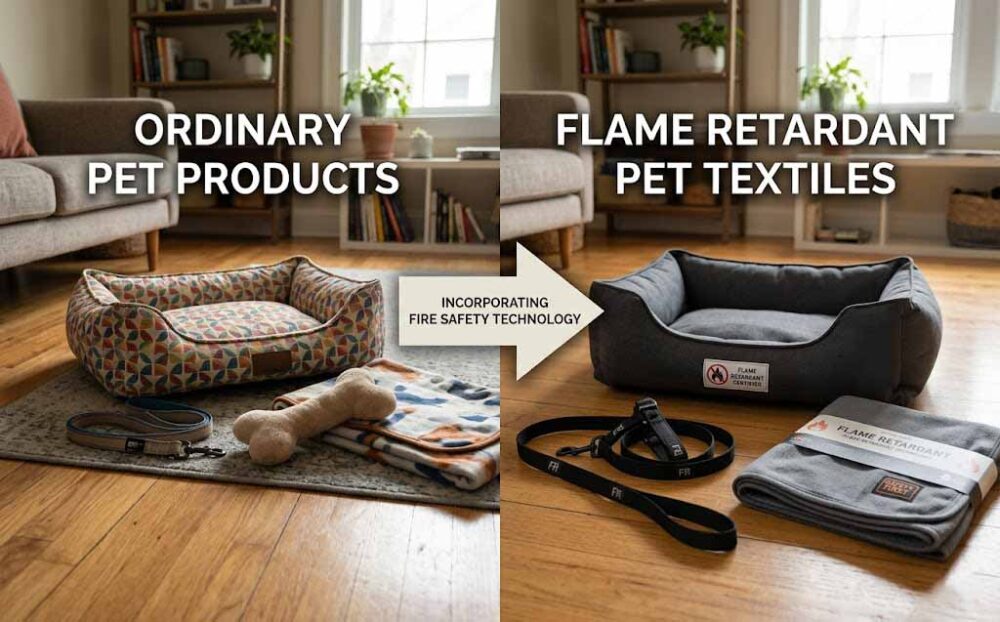
Pet beds, pet mats, sofa covers, and blankets are no longer just simple pet accessories. In many homes, they have become part of the interior décor.
These products are often placed next to sofas, curtains, carpets, heaters, or power strips. Once the usage environment changes, buyers naturally start to judge the product more carefully. They no longer look only at color and hand feel. They also care about washability, durability, odor, and long-term material stability.
If flame-retardant safety can be added on top of these basic requirements, the product value and brand positioning can be raised immediately.
But we need to be clear from the beginning: flame-retardant fabric does not mean completely fireproof. Its role is to delay ignition, slow down flame spread, and provide more response time in certain risk situations.
So, is flame-retardant fabric suitable for pet products? What do overseas buyers really check before placing orders? And how can retail brands use the “safety upgrade” angle without overclaiming?
Let’s break it down from a practical sourcing perspective.
Last quarter, a European pet brand owner told us about a painful case.
They had ordered 8,000 meters of ordinary polyester terry fabric to develop a washable dog bed cover. At first, the fabric looked premium and felt good. But after consumers washed the cover several times at home, the fabric shrank badly. The cover became too tight and could no longer fit back over the foam insert.
After 17 years of working with textiles at BEGOODTEX, we have seen this type of failure many times. It does not happen only in pet products. Similar problems also appear in hotel textiles and healthcare bedding.
The root cause is usually the same: during fabric selection, buyers focus only on photos and sample hand feel, but forget the high-frequency use conditions in real life.
In the past, pet products had a low entry threshold. A simple non-woven bag, low-grade filling, and cheap surface fabric could become a dog bed. Few people cared about technical parameters.
Now the market is different.
A dog bed may be placed beside an electric heater in the living room. A cat mat may sit directly on a carpet, next to full-length curtains. For premium pet brands, many of the questions they ask us today are very similar to those from five-star hotels and major hospitals:
Low-end pet products often use cheap plush fabric, thin polyester fabric, or ordinary knitted fabric. These materials may work for price-sensitive products. But for brands aiming at mid- to high-end markets, they often fail in three areas.
First, poor washability.
If shrinkage exceeds 5%, a removable bed cover can almost become unusable. If the fabric pills badly after a few washes, it will look like an old cleaning rag. If the color fastness is below Grade 3, a premium grey cover may turn into a dull, dirty-looking brown after 10 washes.
Second, weak durability.
Pet claws, daily rubbing, and repeated machine washing can quickly damage loose knitted structures. Many fabrics look thick and solid in product photos, but after two months of use, the surface may become worn, thin, or damaged.
Third, safety blind spots.
Many ordinary fabrics are developed mainly around cost and softness. Fire safety is not considered. When a dog bed is placed near an electric blanket, power strip, or upholstered furniture, both consumers and brands may start to worry.
These pain points are very familiar to us. When we work on hotel curtains, hospital bedding, and workwear fabrics, customer requirements are often even stricter. Now pet brands are moving toward the same technical level, but many still lack practical experience in avoiding material risks.
Pet fabric selection should not be based only on appearance. The real test lies in daily washing, scratching, indoor placement, and long-term material stability.
When pet brands come to us for new fabric development, the first step is usually not flame-retardant testing. We first check the basic performance — the indicators that decide whether a dog bed can actually be used for a long time.
Here are the core evaluation items we often use for pet bed cover fabrics:
| Test Item | What We Check | Typical Requirement |
|---|---|---|
| Martindale abrasion | Surface durability against rubbing and scratching | Home pet covers ≥ 20,000 cycles |
| Shrinkage after washing | Dimensional stability after 40°C machine washing | ≤ 3% after 10 washes |
| Pilling | Surface texture retention | Minimum Grade 3–4 |
| Color fastness to washing | Color stability during cleaning | Minimum Grade 3–4 |
| Color fastness to light | Resistance to indoor fading | Minimum Grade 4 |
| Tear strength | Resistance to scratching and pulling | Warp and weft ≥ 15 N |
| LOI | Basic flammability index for FR fabrics | Inherently FR polyester ≥ 28% |
These are not just theoretical numbers written on paper. They come from years of bulk production and project experience.
For brands exporting products or entering overseas retail channels, we can also support special third-party testing. For example, CAL TB 117-2013 is often considered for North American categories, EN 1021-1/2 may be used for European upholstered furniture, BS 5852 may apply to higher-risk commercial seating, and OEKO-TEX STANDARD 100 may be considered when skin-contact safety is important.

A European customer once asked us directly:
“Can you guarantee this fabric will never burn?”
Our answer was also direct: no, we cannot.
The purpose of flame-retardant fabric is to delay ignition, reduce the speed of flame spread, and provide more time for rescue or escape when a fire source appears. It does not mean the material becomes a metal plate that cannot burn or melt.
This concept is especially important for pet brands because a dog bed is usually a composite product. It may include an outer cover, inner foam pad, lining, zipper, and sewing thread. Even if the outer fabric uses high-quality flame-retardant material, the final fire performance of the whole product still depends on the foam and other components.
Some brands like to use claims such as “100% fireproof” or “absolutely non-burning” on packaging. These are high-risk expressions in many markets. They can mislead consumers and may create legal problems.
It is safer and more professional to say:
“Made with flame-retardant fabric”
or
“Fabric tested to CAL TB 117-2013”
This type of wording is clearer, more compliant, and easier for buyers to accept.
Many foreign trade buyers do not clearly distinguish between fabric testing and composite or finished product testing.
Fabric testing only tests the textile fabric itself. This is what BEGOODTEX can directly provide as a fabric manufacturer, together with test reports for the corresponding batch.
Composite testing tests the fabric together with foam, spray-bonded cotton, backing, or cushion layers as one combined structure.
Finished product testing tests the complete pet bed, sofa cover, or other final product.
If a brand heavily promotes a “flame-retardant dog bed” on its website, consumers may assume the whole bed is flame-retardant. But if only the outer cover fabric has been tested, this can create a grey area.
Our advice to brand customers is always the same: be transparent. If the fabric is flame-retardant, say clearly that the product uses flame-retardant fabric. This is more reliable than vague marketing language.

Not every pet product needs flame-retardant fabric. A basic disposable mat used inside a metal cage may work well enough with ordinary fabric.
But for mid- to high-end pet products designed for indoor home environments, flame-retardant fabric can be a strong value-added feature.
| Product Type | Recommended Fabric | Why Flame Retardancy Helps |
|---|---|---|
| Removable dog bed covers | Inherently FR polyester, FR terry fabric, FR peach skin fabric | Frequently washed, so IFR fabric is better for repeated machine washing |
| Pet sofas / premium pet furniture | FR upholstery fabric, FR velvet, FR chenille | Often placed near furniture or heating devices; needs abrasion resistance and fire safety |
| Sofa protection covers | FR quilted fabric, coated FR polyester | Used directly on household sofas; waterproof and flame-retardant functions can work together |
| Pet blankets | FR terry fabric or soft FR knitted fabric | Daily skin contact requires color fastness, wash durability, and flame-retardant performance |
| Dog house / litter box lining | FR polyester, coated FR fabric | Enclosed spaces require better resistance to rubbing, tearing, and cleaning agents |
For categories that require frequent washing, we usually recommend inherently flame-retardant fabrics first.
The reason is simple. Inherent flame retardancy means the flame-retardant component is built into the fiber structure during the polymer stage. It is not simply added to the surface later.
Ordinary post-finished flame-retardant fabrics may lose performance after repeated washing. In our lab comparisons, after 50 washes, inherently flame-retardant polyester could still pass NFPA 701, while some post-finished fabrics showed a 40% to 60% increase in char length.
We have worked with many pet textile brands exporting to overseas markets. The brands that sell well usually have one thing in common: they do not use “fire safety” as the first selling point to scare consumers.
Instead, they tell a complete material story.
A dog bed that is “soft, washable, durable, and made with flame-retardant fabric” is usually easier to sell than a product marketed bluntly as a “fireproof dog bed.”
Most consumers do not buy pet products while thinking, “My house may catch fire.” They care first about comfort, durability, appearance, and workmanship. Safety can be a valuable upgrade, but it should be communicated carefully.
| Smart and Compliant Wording | High-Risk Wording to Avoid |
|---|---|
| Made with high-quality flame-retardant fabric | 100% fireproof |
| Lab-tested fabric suitable for everyday indoor home use | Completely non-burning |
| Fabric tested to CAL TB 117-2013 | Provides all-day fire protection for pets |
| Removable washable cover with optional FR fabric upgrade | The safest dog bed in the world |
In markets such as Europe and North America, advertising supervision can be strict. If the wording on the right is challenged, brands may face fines, complaints, or product removal.
Flame-retardant fabrics can also be combined with other finishing technologies. We often help customers combine inherently flame-retardant polyester with C0 fluorine-free water-repellent finishing for sofa covers, or use premium FR velvet for higher-end home décor pet products.
To help buyers better understand wash durability, we tested two types of fabrics before and after 50 washes according to NFPA 701 small-scale testing.
| Fabric Type | Char Length Before Washing | Char Length After 50 Washes | Final Result |
|---|---|---|---|
| Inherently FR polyester, 260 g/m² | 62 mm | 78 mm | ✅ Pass |
| Post-finished FR polyester, 250 g/m² | 58 mm | 95 mm | ❌ Fail |
The data shows an important point.
When newly produced, the post-finished fabric may even look better in test data because the flame-retardant layer is still on the surface. But after 50 high-frequency washes, the chemical finish gradually weakens, and the char length exceeds the acceptable range.
Inherently flame-retardant fabric may not look more impressive at the beginning, but its strength is long-term stability.
If your product is a washable bed cover or blanket, the choice becomes much clearer. If the product is upholstered pet furniture that will rarely be washed, a post-finished FR solution may help reduce cost. But before bulk production, wash testing should still be done.
Based on our experience with North American, European, and Middle Eastern pet textile orders, we usually give brand customers the following material suggestions.
Choose inherently FR polyester or FR terry fabric. A weight range of 250–320 g/m² is usually practical.
Shrinkage should be strictly controlled within 3%. Pilling should reach Grade 3–4. LOI should be at least 28%.
The fabric width can usually be developed at 150 cm or 280 cm, depending on cutting layout.
Use FR velvet or chenille. Fabric weight can be around 300–400 g/m².
Martindale abrasion should be above 20,000 cycles, and tear strength should be at least 15 N. This performance level is close to what we would consider for hotel-grade upholstery projects.
Coated FR polyester with water-repellent finishing is often a good solution.
The coating can improve tear resistance, while the surface can be wiped clean more easily when stained.
Batch color difference is one of the biggest issues in repeat orders.
We keep customers’ lab dip standards and use spectrophotometer-based multi-point color matching during repeat bulk production. Many brands reorder two or three times per year, so batch consistency is essential for protecting brand image.
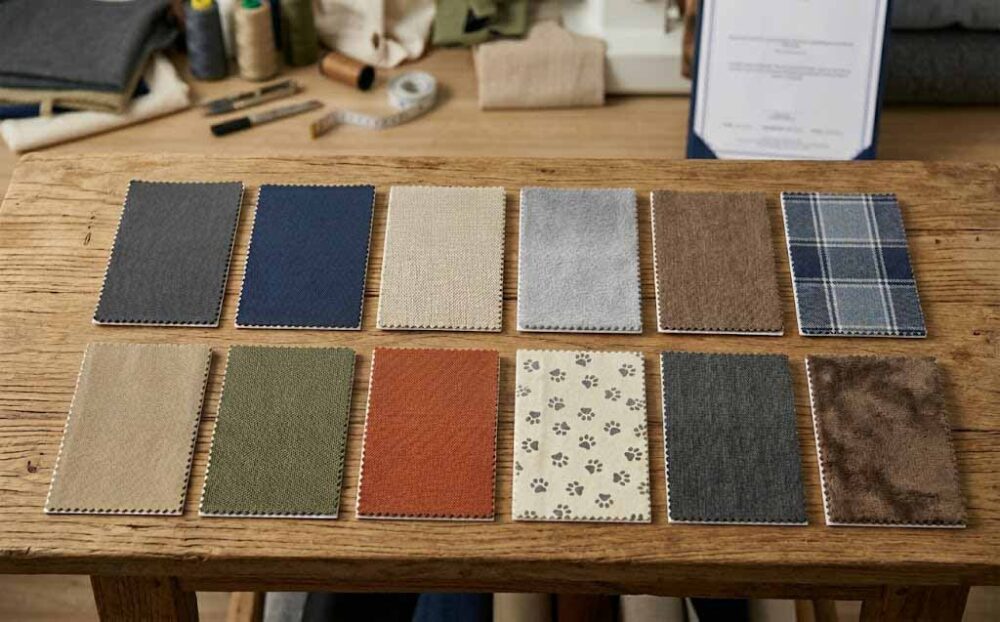
Based on real application needs, BEGOODTEX has developed several customizable flame-retardant pet textile solutions for global buyers. We support customized colors, widths, textures, and functional finishing such as water repellency and antistatic treatment.
Inherently FR polar fleece fabric
Soft and skin-friendly, suitable for premium pet mats, blankets, and removable bed covers.
Super-soft FR plush fabric
Delicate touch, often used for high-end pet toys and skin-contact product lines.
FR laminated faux-linen velvet
Structured and premium-looking, designed for shaped pet sofas and decorative surfaces.
Coated FR waterproof polyester fabric
Abrasion-resistant and water-repellent, suitable for sofa protectors and easy-clean bed covers.
Everyday FR bedding-type fabrics
Suitable for extended pet pillow products and home textile accessories.
With our supply chain and in-house lab support, we can discuss flexible MOQ options, provide third-party test reports, and help brands compare the cost-performance balance between inherently flame-retardant and post-finished flame-retardant solutions.
The goal is to help you choose the most suitable material for your target market.
 Inherent Flame Retardant Polyester Terry Fleece Bedding Fabric with Antibacterial Protection | 155 g/m² | 150 cm | BS 5815
 Flame Retardant White Single-Sided Polyester Fleece Fabric for Hotel and Events with Wholesale and Custom Supply Options | 355 g/m² | 150 cm
 Inherent Flame Retardant Polar Fleece Fabric in Light Pink, Polyester for Sleepwear with Bulk Order Support | 360 g/m² | 150 cm | CFR 1615/1616
 Inherent Flame Retardant Polar Fleece Polyester Fabric in Pink for Sleepwear from a China Textile Mill | 190 g/m² | 150 cm | CFR 1615/1616
 Inherent Flame Retardant Coral Fleece Printing Polyester Fabric in Light Blue for Sleepwear | 265 g/m² | 150 cm | CFR 1615/1616
The home-style upgrade of pet products is already an irreversible trend.
When consumers buy a dog bed today, they care about whether it fits into the living room, whether it shrinks after washing, whether it pills or tears after daily scratching, and whether it feels safe when placed near a heater.
Ordinary fabrics are enough for low-price products. But if a brand wants to build value and reputation, abrasion resistance, high color fastness, dimensional stability, and reasonable flame-retardant performance become important barriers for premium product lines.
For brands that want to discuss specific specifications or request samples, BEGOODTEX Lab can support product development with real testing data and finished-product thinking.
Not all pet products need flame-retardant fabrics. Low-cost disposable mats can use ordinary fabric. Mid- to high-end pet beds, pet sofas, pet blankets, sofa protection covers, and indoor décor pet products are more suitable for flame-retardant fabric upgrades.
No. Flame-retardant fabric does not mean completely fireproof. Its function is to delay ignition, reduce flame spread, and help the material self-extinguish under certain conditions. Brands should avoid claims such as “100% fireproof” or “absolutely non-burning.”
Not necessarily. A flame-retardant test report for the outer cover only proves the fabric’s performance. A complete pet bed also includes foam, filling, lining, zipper, and sewing thread. If the brand wants to claim the whole product is flame-retardant, finished product testing is usually needed.
Flame-retardant pet fabrics are more suitable for pet bed covers, pet mats, pet sofas, sofa protection covers, pet blankets, car pet mats, pet hotels, and soft furnishing products for pet hospitals. These products are often used indoors and may be placed near furniture, electrical appliances, or heating devices.
Inherently flame-retardant fabric gets its flame-retardant performance from the fiber itself, making it more suitable for repeated washing and long-term use. Post-finished flame-retardant fabric relies on finishing chemicals. It may cost less, but its performance after washing needs to be confirmed.
In addition to flame-retardant testing, buyers should check abrasion resistance, shrinkage, pilling, color fastness, tear strength, and odor. For removable washable bed covers, shrinkage is especially important and should preferably be controlled within 3%.
Yes. Many pet sofa covers, car pet mats, and easy-clean bed covers require both flame retardancy and water repellency. However, waterproofing, coating, and flame-retardant finishing can affect each other, so sample testing is recommended before bulk production.
Recommended wording includes “made with flame-retardant fabric,” “fabric tested to relevant flame-retardant standards,” or “available with flame-retardant fabric upgrade.” Avoid misleading expressions such as “completely non-burning,” “100% fireproof,” or “the safest pet bed in the world.”
Buyers should first confirm the product type, target market, washing requirements, whether fabric testing or finished product testing is needed, the required flame-retardant standard, and whether additional functions such as waterproofing, antibacterial finishing, antistatic performance, or OEKO-TEX documentation are required. After these points are clear, discussions about weight, hand feel, color, and price will be much more reliable.