Get in touch
Thank you for reaching out! Please tell us more about your needs — our expert team will get back to you within 24 hours.




Adults aged 65 and older face 2.5 times the risk of dying in a fire compared to the general population — and for those 85 and above, that risk climbs to 3.4 times (U.S. Fire Administration, 2023). In care facilities and senior homes worldwide, flame retardant fabric serves as the thin barrier between a minor ignition and a catastrophic fire. As the global silver economy surpasses $4.2 trillion in 2025, protecting an aging population demands more than smoke detectors — it requires rethinking the textiles that surround older adults every day.
If you manage a senior living community, design elderly care products, or care for an aging family member, you already know that fire safety is a life-or-death concern hiding in plain sight. What you may not realize is how much the textiles around older adults — bedding, upholstery, curtains, sleepwear — shape that risk. What follows is a practical look at how flame retardant fabrics work as a safety layer: the fire-risk data, the fabric technology, the compliance standards, and the procurement decisions that actually matter.
Key Takeaways
The numbers should alarm every care facility manager and family caregiver. According to the U.S. Fire Administration (USFA), 1,955 adults aged 65 and older died in fires in 2023 — a rate of 33.0 deaths per million population. The trend is worsening: the fire death rate for older adults increased 26% from 2014 to 2023, with the 65–74 age group experiencing a 41% increase.
Globally, the pattern holds. A 2020 study in Fire and Materials (Wiley) noted that “older people, those aged 60 and over, are over-represented in fatal fire statistics across the globe.” This isn’t a localized problem — it’s a worldwide crisis accelerating alongside demographic aging.
Several factors combine to make older adults uniquely susceptible:
See how flame retardant fabrics hold up against standard textiles in real fire tests — FR fabric specifications →
Most facility operators miss this: textiles are the primary fuel in most fire incidents. Textiles cause roughly 50% of fires worldwide (Springer, 2023). Mattresses, upholstery, curtains, and bedding don’t just burn — they accelerate fire spread, generate toxic smoke, and shrink escape windows from minutes to seconds.
When a dropped cigarette ignited a mattress in a Midlands care home in 2022, staff had under three minutes to evacuate 14 residents — several with advanced dementia and limited mobility. The facility had recently upgraded to BS 7175 Crib 5 compliant bedding. The flame self-extinguished before reaching the mattress core. No one was injured. The £3,200 bedding upgrade had been contentious at the budget meeting. That night, it saved 14 lives.
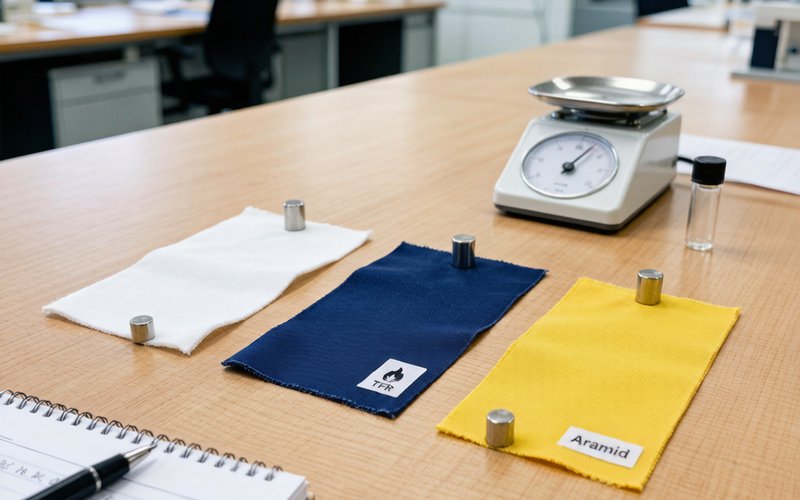
Flame retardant fabric is treated or engineered to resist ignition and slow flame spread, while flame resistant (or fire resistant fabric) inherently resists burning due to its chemical structure. In practice, most buyers use the terms interchangeably, though “retardant” typically implies a treatment process and “resistant” implies inherent material properties.
Inherently flame retardant (IFR) fabrics have fire-resistant properties built into the fiber polymer at the molecular level. The protection cannot be washed out or degraded over time. Modacrylic and certain aramid fibers are classic IFR examples. While initially more expensive, IFR fabrics maintain protection through hundreds of wash cycles — a crucial advantage in care facilities.
Treated flame retardant (TFR) fabrics receive a chemical coating that imparts fire resistance. These are less expensive upfront but may lose effectiveness after repeated washing, abrasion, or UV exposure. For senior environments requiring frequent laundering at 75°C and above, TFR fabrics may need retreatment within 20–30 wash cycles.
The silver economy — all economic activity driven by people aged 60 and older — was valued at $4.2 trillion in 2025, growing at 7.6% annually (SilverEconomy.com, 2025). It spans health and wellness ($1.3T), living solutions ($1.1T), financial services ($1.0T), leisure ($0.8T), and AgeTech ($279B).
Consider the scale: 1.2 billion seniors — 15% of the global population — growing three times faster than the overall population. By 2050, people aged 60+ will exceed 2 billion. China’s silver economy alone is projected to reach 30 trillion RMB (~$4.18T) by 2035.
Three forces tie the silver economy directly to flame retardant fabric demand:
The global flame retardant fabrics market is projected to grow from $1.68 billion in 2025 to $2.58 billion by 2034 — a compound annual growth rate (CAGR) of 4.9% (Fortune Business Insights, 2025). Home textiles are the largest end-use segment, at 29.55% of market share. Asia-Pacific holds 44.5% of global demand, tracking the region’s rapid aging. As silver economy infrastructure expands, FR fabric demand rises in lockstep.
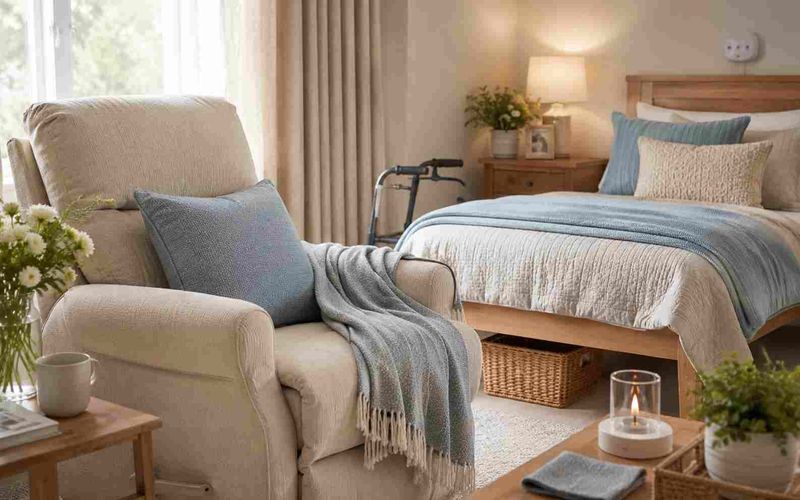
Bedding represents the highest-risk textile category in senior environments. Mattresses and bedclothes are the first items ignited in many fatal senior fires — often by dropped cigarettes, electric blanket malfunctions, or overheating medical devices.
In the US, mattresses must comply with 16 CFR Part 1632 (smoldering cigarette ignition) and 16 CFR Part 1633 (open-flame resistance). In the UK and many international care facilities, BS 7175 Crib 5 (the highest hazard category for bedding where escape is difficult) is the benchmark for bedcovers and pillows in high-risk institutional settings. These standards give staff critical additional minutes to respond.
Senior living furniture — recliners, lift chairs, bedside chairs, communal seating — must meet stringent flammability standards. California Technical Bulletin 117 (CA TB 117) and NFPA 260 classify upholstery by fire performance, with care facilities typically requiring the highest classification.
Recliners and lift chairs are particularly critical. Their motorized components can fail, and foam padding is highly combustible. Wrapping internal foam in flame retardant barrier fabrics and using FR upholstery covers significantly reduces fire severity.
Curtains create a vertical fire pathway that can spread flames from floor to ceiling in seconds. In care facilities, window treatments in shared lounges, corridors, and resident rooms must comply with NFPA 701, which tests fire propagation resistance for textiles and films.
Flame retardant curtains for nursing homes do two jobs at once: they meet code and actively slow fire spread. Facilities prefer IFR drapery fabrics because they hold compliance through repeated laundering.
There is a regulatory gap many don’t see: while children’s sleepwear is strictly regulated for flammability (16 CFR Parts 1615/1616), adult sleepwear faces no equivalent federal standard in the United States. For seniors who smoke, use oxygen, or cook independently, this gap is a hidden risk.
Academic researchers are exploring FR sleepwear solutions for elderly populations, combining comfort with ignition resistance. Until regulations catch up, care facilities and caregivers should consider specifying flame retardant fabrics for resident nightclothes as a voluntary safety measure.
Privacy curtains — fabric dividers between beds in shared rooms — must comply with BS 5867 Type C (UK) or NFPA 701 (US). The procurement challenge is durability: curtains in high-turnover facilities may be laundered weekly at 75°C. Treated FR fabrics may lose their coating after 20–30 washes, creating silent compliance failures. IFR fabrics maintain protection through 50+ washes.
During a 2023 fire safety audit of a 120-bed assisted living facility in Ohio, consultant Marcus Webb discovered that 40% of privacy curtains had been laundered beyond their TFR treatment lifespan. “The facility was technically non-compliant and didn’t know it,” Webb recalled. “The curtains looked fine. But the flame retardant coating had been washed out months ago.” The facility switched to IFR curtains, eliminating the retreatment cycle. Total cost over three years was 18% lower.
Compare standards, materials, and wash-durability in our care facility compliance checklist →
Navigating fire safety standards for senior living requires understanding both US and international frameworks. Selecting the right fire safety fabric for senior living environments means knowing which standards apply to each textile category.
Compliance is an ongoing obligation. Operators should:

When people think of fire fatalities, they picture burns. But smoke inhalation — not flame — is the leading cause of fire death. Most victims succumb to toxic gases — carbon monoxide, hydrogen cyanide, hydrogen chloride — long before flames reach them.
For seniors, this danger is amplified. Reduced respiratory capacity and slower evacuation mean more toxic smoke inhaled per second of exposure. COPD, asthma, and age-related lung decline — common among older adults — mean seniors experience smoke-related crises at far lower exposure levels. A fire causing discomfort in a younger person can be fatal to a senior with COPD within minutes.
Traditional FR treatments often rely on halogens — bromine- and chlorine-based compounds — that release toxic gases when burned. Hydrogen cyanide from burning synthetics and hydrogen chloride from PVC-coated materials are particularly dangerous in confined care environments.
Halogen-free FR fabrics use phosphorus-based or nitrogen-based systems that generate significantly less toxic smoke, giving elderly residents a wider survival window. For facilities serving residents with respiratory conditions, specifying low-smoke, low-toxicity flame retardant fabrics should be a procurement priority.
In institutional care, textiles face relentless laundering — bedding daily at 75°C, privacy curtains quarterly, upholstery annually. The flame retardant fabric you choose must maintain fire-resistant properties through this lifecycle. IFR fabrics are the clear winner: their protection is molecular, not topical. Modacrylic curtains withstand 50+ industrial washes without degradation. TFR fabrics may require retreatment after 20–30 cycles.
Elderly skin is fragile. Thinning epidermis, reduced elasticity, and conditions like diabetes make seniors susceptible to pressure sores and allergic reactions. For direct skin contact applications — bedding, sleepwear, clothing — look for OEKO-TEX 100 certification, which verifies freedom from harmful chemical concentrations. Soft-touch modacrylic blends balance protection with comfort.
| Factor | IFR Fabric | TFR Fabric |
|---|---|---|
| Upfront cost | Higher | Lower |
| Wash durability | 50+ cycles | 20–30 cycles |
| Retreatments | None | Every 20–30 washes |
| Compliance risk | Minimal | Moderate |
| 3-year TCO | Lower | Higher |
Facility managers who choose TFR to save upfront often spend more over three years due to retreatment labor, compliance failures, and premature replacement.
When Janet Morris redesigned her mother’s home for aging-in-place in 2024, she balked at the $1,800 cost of IFR bedding, curtains, and upholstery covers. Her fire safety consultant pointed out that her mother used an electric blanket nightly and had mild cognitive impairment — two significant risk factors. Janet proceeded with the upgrade. “The peace of mind alone was worth it,” she said. “Knowing the curtains won’t become a fire ladder to the ceiling — that’s something I don’t have to worry about.”
Sustainability is no longer optional in B2B textile procurement. Eco-friendly FR treatments using bio-based phosphorus compounds, recycled modacrylic fibers, and water-efficient manufacturing are entering the market. While some carry a price premium, they align with ESG (environmental, social, and governance) commitments and public procurement requirements in Europe and North America.
The next generation of flame retardant fabric does more than resist fire — it detects it. Researchers are developing intelligent fire-warning coatings that change color or emit electrical signals when exposed to heat, potentially integrating with facility alarm systems. For environments where residents may not report early fire signs, smart FR fabrics could provide critical early detection.
Care facilities face dual challenges: fire safety and infection control. Multifunctional fabrics combining antimicrobial properties with flame retardancy address both — silver-ion treatments on IFR base fabrics protect against pathogens and fire simultaneously. Meanwhile, as more seniors age in place, residential FR textile packages — fire resistant bedding, FR upholstery covers, flame retardant curtains — are becoming standard in home safety assessments.
Contact our textile specialists → to discuss FR fabric requirements for your senior living project.
Flame retardant fabrics are chemically treated to resist ignition and slow flame spread, while flame resistant fabrics have inherent fire-resistant properties built into the fiber structure. The terms are often used interchangeably, though “retardant” implies a treatment process and “resistant” implies inherent material properties.
Yes, when properly specified. Look for OEKO-TEX 100 certified FR fabrics, which verify freedom from harmful chemical concentrations. Soft-touch modacrylic blends and skin-safe treated cotton provide both flame protection and comfort for fragile elderly skin. Avoid harsh brominated treatments for direct skin contact.
US: NFPA 101 (Life Safety Code) for healthcare facilities, NFPA 701 for curtains/drapes, 16 CFR Parts 1632/1633 for mattresses
UK: BS 5867 Type C for curtains, BS 7175 Crib 5 for bedding
Germany: DIN 4102 B1 for building materials
Compliance requires documented test certificates for all FR textiles.
Treated (TFR) fabrics can lose effectiveness after 20–30 wash cycles as the chemical coating degrades. Inherently flame retardant (IFR) fabrics maintain full protection through 50+ industrial washes because their resistance is molecular. For high-laundering environments like care facilities, IFR fabrics are strongly recommended.
Wool and modacrylic are naturally flame resistant. Wool has a high ignition temperature and self-extinguishes when removed from flame. Modacrylic fibers contain fire-resistant polymers in the fiber structure. Aramid fibers like Nomex and Kevlar also offer inherent flame resistance that never degrades.
The intersection of fire safety and the silver economy is a public health imperative. Adults 65+ face 2.5 times the fire death risk of the general population, and that risk is rising. Textiles cause roughly half of all fires worldwide, making fabric selection one of the most impactful safety interventions available.
Three things stay true as the silver economy grows: senior fire risk is still rising — 1,955 deaths in 2023. IFR fabrics beat treated ones on both safety and three-year cost. And the standards that matter — NFPA 101, 16 CFR 1632/1633, BS 7175 Crib 5, NFPA 701 — are the ones your next audit will check.
Whether you’re specifying textiles for a new care facility, upgrading an existing one, or making a home safer for an aging parent, the right flame retardant fabrics save lives. Download our care facility compliance checklist → and take the first step toward comprehensive fire safety today.