Enter your details and we will send the requested document to your inbox.





Last year, a regional theatre in Melbourne ripped out every stage curtain days before opening night. Their “flame-retardant” fabric had passed AS 1530.2 testing at installation. After months of humidity and one dry-clean cycle, it failed re-testing with a Flammability Index of 38 — nearly four times the legal limit. No certifier in Australia signs off without compliant test documentation.
Below: which parts of AS 1530 matter for fabrics, how the tests work, and what to verify before you sign that PO for AS 1530 flame retardant fabric.

Four parts. Only two matter for fabrics. Mix them up and your compliance report is worthless.
AS 1530 is a four-part standard series developed by Standards Australia and reconfirmed in 2016. For a broader technical overview of the full series, including Parts .1 and .4, see Intertek’s overview of the AS 1530 standard series.
| Part | Test Scope | Applies to Fabrics? |
|---|---|---|
| AS 1530.1 | Combustibility | No — rigid building materials only |
| AS 1530.2 | Flammability | Yes — thin, pliable woven materials |
| AS/NZS 1530.3 | Ignitability, flame propagation, heat release, smoke | Yes — fabric used as wall linings |
| AS 1530.4 | Fire resistance | No — structural assemblies only |
We’ve seen projects submit AS 1530.1 reports for curtains. Certifiers reject them on the spot. .1 tests rigid materials, not textiles.
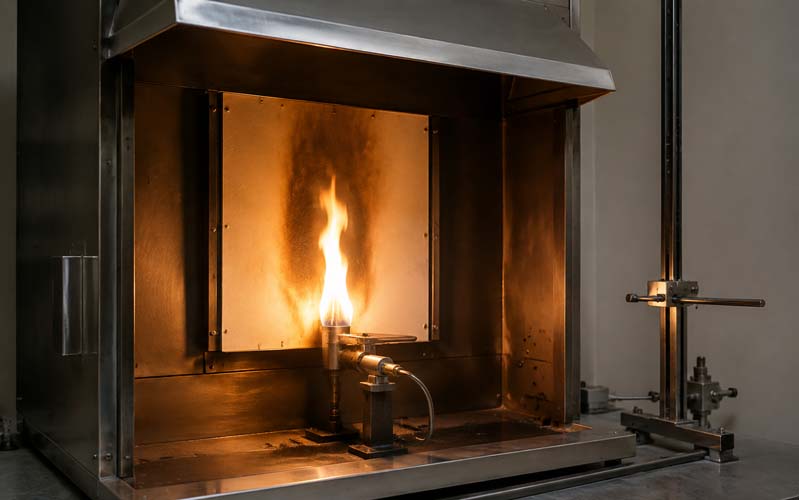
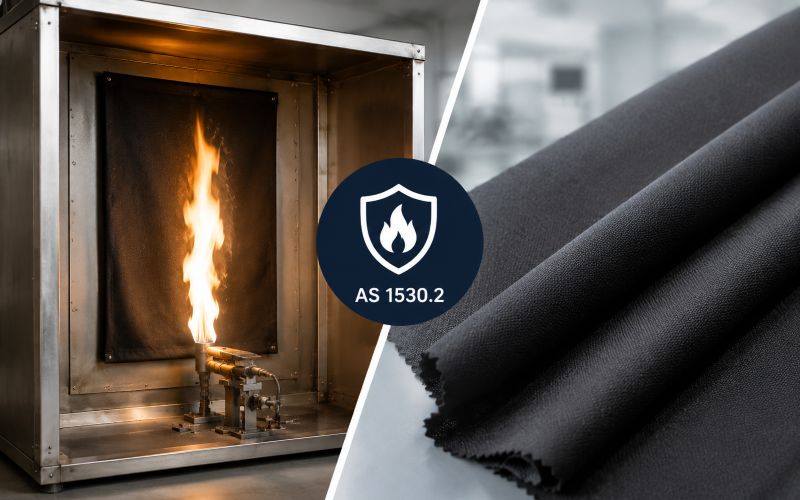
AS 1530 flame retardant fabric testing under AS 1530.2 subjects a fabric specimen to vertical flame exposure inside a controlled chamber.A radiator generates intense heat while the specimen is positioned so flame spread can be measured precisely. Simple setup. Serious consequences. The test records ignition time, flame spread extent, and heat output under standardised conditions. It applies to thin, flexible materials that can be inserted into the apparatus by hand.
The AS 1530.2 flammability index is a composite score from 0 to 100. Zero means non-combustible. One hundred means extremely flammable. Three sub-factors drive the score:
For NCC/BCA compliance, a Flammability Index ≤ 10 is the accepted threshold in Australia. New Zealand requires ≤ 6. These thresholds mark the point where an AS 1530 flame retardant fabric’s contribution to fire growth stays manageable within a building’s fire-engineered design.
That Melbourne theatre? Their NDFR curtains scored 8 at installation. Months of humidity and one dry-clean cycle later, the topical FR treatment leached out. The Index hit 38. They replaced every curtain before reopening. Moisture and cleaning destroy surface-applied retardants. Inherent FR avoids this risk.
AS/NZS 1530.3 measures four fire-performance characteristics in a single test:
| Index | Scale | Measures |
|---|---|---|
| Ignitability | 0–20 | How easily the material ignites under radiant heat |
| Flame Propagation | 0–20 | How quickly flame spreads once ignited |
| Heat Release | 0–20 | The rate and volume of heat contributed |
| Smoke Developed | 0–10 | The quantity and density of smoke produced |
Each index is read independently. The NCC uses these to assign a Fire Hazard Group rating (Group 1–4, where Group 1 is lowest hazard). For wall linings, the code specifies maximum allowable group numbers, and the AS/NZS 1530.3 indices determine which group a fabric falls into.
Free-hanging curtain? AS 1530.2. Wall-fixed fabric? AS/NZS 1530.3. Wrong test, wrong compliance path. Confirm your installation method before ordering tests.
The National Construction Code (NCC) Volume One — formerly the Building Code of Australia (BCA) — sets fire-hazard property requirements for Class 2 through Class 9 buildings: residential flats, hotels, offices, shops, healthcare facilities, schools, and entertainment venues. For each class, the code mandates minimum fire performance for interior linings, including curtains and drapes.
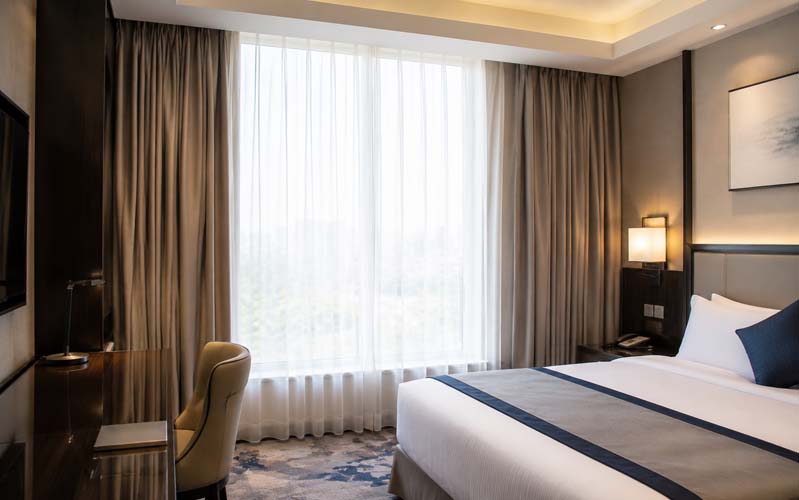
Class 9b buildings — theatres, cinemas, churches, nightclubs — face the most stringent requirements. Dense occupancy and complex egress paths make AS 1530 flame retardant fabric performance a life-safety issue. Curtains in a 9b venue must carry valid NCC BCA compliance flame retardant test documentation.
State regulations can override or supplement the NCC. Queensland has additional fire-safety provisions; NSW and Victoria apply local amendments. Always cross-reference with your project’s state authority.
| Type | Definition | FR Persistence | Best Use |
|---|---|---|---|
| IFR | Flame resistance built into the fibre’s chemical structure | Permanent; survives washing, dry-cleaning, abrasion | Hotels, theatres, healthcare |
| DFR | Chemical retardant bonds to the fibre post-weaving | Long-lasting; resists multiple washes, may degrade over years | Medium-term commercial interiors |
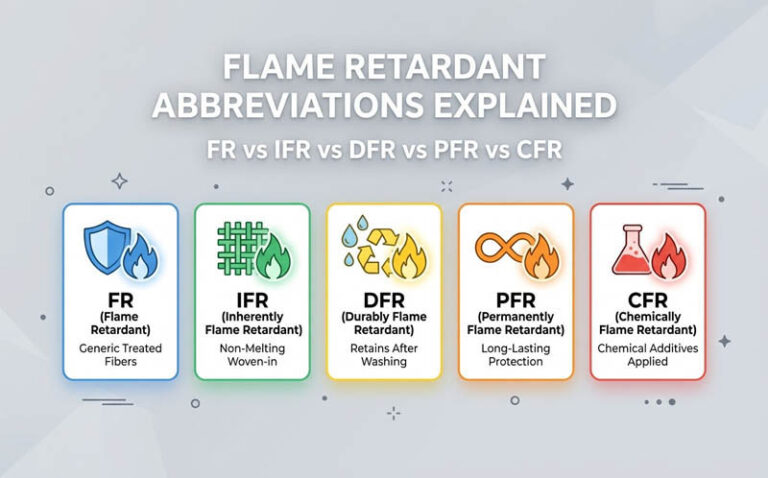
| NDFR | Surface-applied retardant without chemical bonding | Short-lived; moisture or cleaning can strip it entirely | Short-term events only — never permanent installations |
For long-term projects, IFR is the only sensible choice. A hotel group across Sydney, Melbourne, and Brisbane shifted all 4,200 rooms to IFR curtains after discovering NDFR drapes in 30% of properties had lost compliance between inspections. Learn how IFR fabrics perform in hospitality projects. The upfront cost was higher — roughly $1.20–2.50 per curtain — but lifecycle cost dropped because IFR never needs retreatment or re-testing.
A supplier says their fabric is FR. An accredited lab says otherwise. That gap is where 60% of imports fail, according to a 2024 audit of self-certified FR fabrics.
For a full list of accredited certifications across AS 1530, NFPA 701, and BS 5867, see Begoodtex’s certification portfolio.
Need AS 1530-certified fabrics with verified test reports? Explore Begoodtex’s flame-retardant fabric range →
Does NFPA 701 compliance satisfy AS 1530 requirements in Australia?
No. NFPA 701 and AS 1530 use different testing methods and pass criteria. A fabric passing NFPA 701 may fail AS 1530.2’s Flammability Index threshold. Australian certifiers require AS 1530 specifically.
What flammability index is needed for NCC compliance?
A Flammability Index of ≤ 10 under AS 1530.2 meets the Australian NCC threshold. New Zealand requires ≤ 6.
How long are AS 1530 test reports valid?
Most accredited-lab AS 1530 test reports are valid for 1–2 years. Outdated reports may not reflect current production and should be renewed before project submission.
Here’s how AS 1530 compares with the most common international fire standards for flame retardant fabrics:
| Standard | Region | Method | Pass Criteria | Applies To |
|---|---|---|---|---|
| AS 1530.2 | AU/NZ | Vertical flame + radiant heat | Flammability Index ≤ 10 (AU), ≤ 6 (NZ) | Free-hanging curtains, drapes |
| AS/NZS 1530.3 | AU/NZ | Radiant panel; four indices | Group 1–4 classification | Wall linings |
| NFPA 701 | USA/Canada | Vertical flame (Method 1) / large-scale (Method 2) | After-flame time, char length, mass loss | Public-space drapes |
| BS 5867 Pt 2B/2C | UK | Vertical flame | After-flame ≤ 5s (Type B) | Curtains, drapes |
| EN 13773 | EU | Small burner | Class 1–3 | Curtains, drapes |
The key difference in the AS 1530 vs NFPA 701 comparison: AS 1530 evaluates flame spread speed, extent, and heat release as composite factors, while NFPA 701 focuses on after-flame duration and char length. A fabric passing NFPA 701 may not meet AS 1530.2’s threshold. On Australian soil, AS 1530 is the standard that matters for any flame retardant fabric specification. Your certifier will not accept NFPA 701 or BS 5867 as a substitute.
We supply fabrics certified to AS 1530, NFPA 701, and BS 5867 — learn about Begoodtex’s certifications →
Two parts matter, one index governs, and IFR stays compliant after cleaning. Everything else is risk. Verify every supplier with accredited third-party reports. Never assume a US or UK certification transfers to Australian law.
For architects, fire consultants, and procurement managers specifying AS 1530 flame retardant fabric, Begoodtex provides inherently flame-retardant textiles with verified test documentation. See Begoodtex’s AS 1530 certifications →
AS 1530.2 is an Australian fire test standard for thin, flexible materials such as curtains and drapes. It evaluates ignition, flame spread, and heat response to calculate the Flammability Index.
For Australian NCC compliance, AS 1530.2 fabrics generally require a Flammability Index of 10 or below. A lower index indicates better flame resistance and reduced fire growth risk.
AS 1530.2 testing is commonly required for free-hanging curtains, stage drapes, and other flexible textile materials used in commercial buildings, public spaces, and hospitality projects.
No. NFPA 701 and AS 1530.2 use different testing methods and requirements. Australian projects requiring AS 1530 compliance need specific AS 1530 test reports.
IFR fabric has permanent flame resistance built into the fibre structure. It maintains fire performance after washing, cleaning, and long-term use, making it suitable for demanding commercial applications.
IFR fabric has built-in flame resistance, while DFR fabric uses chemical treatment after weaving. IFR usually provides more stable long-term fire performance for permanent installations.
Request accredited laboratory reports, matching product specifications, and current test documentation. The report should match the exact fabric composition, weight, and construction used in your project.
AS 1530 tested fabrics are widely used in theatres, hotels, hospitals, offices, schools, and public buildings. Common applications include curtains, drapes, and interior textiles requiring fire safety compliance.