Enter your details and we will send the requested document to your inbox.





Waterproof and oilproof textiles sit at the demanding edge of functional fabric engineering. As textiles move into harsher environments—outdoor gear, contract interiors, medical spaces, and protective workwear—basic water-resistant coatings are no longer enough. Buyers now expect fabrics that shrug off both water and oil-based stains while still meeting flame-retardant (FR) codes. These waterproof and oilproof textiles combine liquid repellency with certified fire safety, and this guide explains what they are, how the repellency is engineered, how they are made, and how their performance is tested.
Featured snippet: Waterproof and oilproof textiles are fabrics treated—or built—so their surface repels liquid water and resists wetting by oils. Repellency comes from lowering the fabric’s surface energy (waterproofing) and pushing the oil contact angle above zero (oil repellency), most durably achieved with fluorinated “three-proof” finishes that also deliver stain resistance.

Waterproof and oilproof textiles describe fabrics engineered so their surface sheds water droplets and resists greasy, hydrocarbon-based stains at the same time. A fabric’s water repellency shows how well it repels water on contact; add oil resistance and you get a material suited to commercial kitchens, transit seating, and healthcare settings where spills are constant.
Over the past few decades, fluorinated chemistry has dominated this space. DuPont first patented emulsion-based water- and oil-resistant finishes, and 3M later developed perfluorocarboxylate treatments that set the benchmark for oil repellency. Modern waterproof and oilproof textiles use two mature material routes. The first is ultrafine-fiber high-density fabric, where fiber spacing is smaller than a water droplet yet larger than a water vapor molecule—giving waterproofing and breathability with no coating at all. The second borrows from nature: the lotus-leaf effect lets water bead and roll off, while superhydrophobic surfaces (contact angle >150°) repel both water and oil.
Nanotechnology now scales these principles, applying nano-functional agents by dip, spray, or coating to summer and transitional apparel. For a structured look at the category, see our waterproof fabric classification guide, and for the breathable side of the same coin, our overview of waterproof and breathable fabrics.
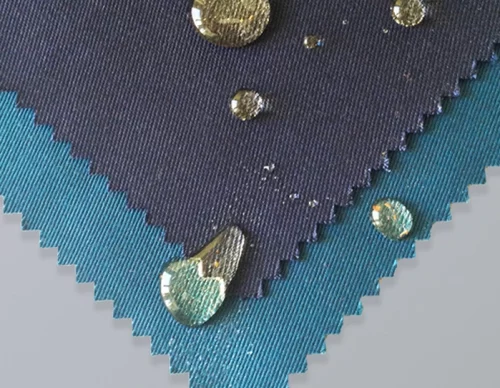
The repellency of waterproof and oilproof textiles rests on a single physical idea: surface energy. A fabric becomes water-repellent when a low-energy substance adsorbs onto its naturally high-energy surface; the lower the surface energy, the stronger the effect. Formulators choose paraffin, siloxane, or fluorine-containing compounds depending on the performance target.

Oil repellency follows the same logic but with a stricter bar. After a water-repellent finish, fabric must resist water penetration under pressure (contact angle >90°). Oil repellency only requires that oil not spread on the surface—its contact angle just needs to be greater than zero. Because oil’s interfacial free energy is far lower than water’s, achieving oil repellency demands an even lower solid–gas interfacial tension, generally below the oil’s own surface tension.
Anti-fouling and easy-clean effects build on top of this. Hydrophilic anti-soil treatments lower fiber surface tension so dirt releases during washing instead of bonding to the fabric. The industry trend now fuses fluorine-based agents with other functional finishes—wrinkle resistance, antibacterial, UV protection—giving rise to the well-known “three-proof” (三防) and “four-proof” (四防) concepts in textile finishing. Certifying waterproof and oilproof textiles for these combined functions requires consistent, measurable test methods.
| Finishing agent | Water repellency | Oil repellency | Durability | Typical use |
| Paraffin / wax | Good | Poor | Temporary | Industrial textiles |
| Reactive classes | Good | Fair | Durable | Workwear, upholstery |
| Silicones | Very good | Fair | Durable | Soft-handling apparel |
| Organic fluorides | Excellent | Excellent | Durable | Three-proof functional fabrics |

Producing waterproof and oilproof textiles starts with the finishing chemistry. Common waterproof agents include paraffin aluminum-soap emulsions, quaternary ammonium and chromium stearate complexes, melamine derivatives, silicones, and organic fluorine compounds—the last prized for combining water, oil, and stain resistance in one finish.
Finishes split into three practical groups:
Durable waterproof and oilproof textiles rely on fluorinated “three-proof” finishing, which lays a protective film that adds water, oil, and soil resistance at once. Traditional “four-proof” finishing used two baths and was slow and resource-heavy; modern single-bath agents reach the same result more efficiently. To see how FR chemistry is combined with these routes, read our explainer on how flame-retardant fabrics are made.

Waterproof and oilproof textiles must prove their performance in the lab before buyers can trust them. Three test families matter most:
Breathability is checked separately with an air-permeability instrument. The reference scales come from standards bodies such as AATCC. For the broader picture, our textile FR testing standards guide covers how protective fabrics are qualified across regions.
BEGOODTEX engineers three-proof functional FR fabrics by applying a durable protective film to a flame-retardant base cloth. The film repels water without blocking pores, so the fabric stays both waterproof and breathable—the same “three-proof” principle described above, fused with certified fire safety. Our waterproof and oilproof FR line serves demanding environments where weather, grease, and fire risk overlap.
Typical applications include:
Because the water- and oil-repellent film sits on top of an inherently or durably flame-retardant substrate, buyers get multi-hazard protection from a single fabric.

Water-resistant describes a fabric that slows water penetration; waterproof describes one that blocks it under pressure. True waterproof textiles either use a continuous membrane or a high-density construction that stops liquid water while (in breathable versions) letting vapor through.
Oil repellency relies on very low surface energy. A finish lowers the fabric’s solid–gas interfacial tension below the oil’s surface tension, so oil beads up and fails to spread. Fluorinated finishes achieve this most reliably and durably, which is why waterproof and oilproof textiles usually specify a fluorinated agent.
“Three-proof” (三防) refers to a fabric finished for water repellency, oil repellency, and stain or soil resistance at once. Some specifications add breathability or antibacterial performance to reach “four-proof” (四防).
It depends on the chemistry. Temporary wax or soap finishes wash out quickly. Durable reactive, silicone, and especially fluorinated finishes survive repeated launderings, though all gradually lose repellency as surface energy rises—so check the wash-durability rating before specifying waterproof and oilproof textiles.
Water repellency is graded by the AATCC 22 spray test and hydrostatic pressure; oil repellency by graded hydrocarbon liquids; easy-clean by stain and rub methods. Independent standards such as AATCC provide the reference scales buyers should ask suppliers to report.
Waterproof and oilproof textiles are no longer a specialty—they are a baseline expectation wherever fabric meets weather, grease, and regulation. The technology rests on a simple principle (lower surface energy) delivered through mature routes: high-density construction, biomimetic coatings, and fluorinated three-proof finishes.
Key takeaways for buyers:
Specify waterproof and oilproof textiles that repel water, oil, and flame in one fabric by exploring BEGOODTEX’s multifunctional FR fabrics.