Enter your details and we will send the requested document to your inbox.





As 2026 draws to a close, what flame retardant fabric sourcing trends should global buyers be preparing for in 2027?
The most important shift is not simply the arrival of more fire standards. Buyers are applying more specific checks to product evidence, supply-chain information, chemical requirements, and project delivery.
They increasingly need to know whether a test report actually matches the product being sourced, whether production information can be traced, whether the material meets chemical requirements in the destination market, and whether bulk production remains consistent with the tested and approved sample.
For global FR fabric sourcing, 2027 is best understood as a point where several sourcing requirements begin to converge.

| What Buyers Should Watch | Verified Change | What It Means for Sourcing |
|---|---|---|
| Product-level test evidence | Project reviews increasingly focus on the exact product, test, and sourcing specification. | Do not stop at asking whether a certificate exists. |
| Supply-chain transparency | The EU Forced Labour Regulation applies from 14 December 2027. | Production locations and source information matter more. |
| Product data management | The EU plans further textile-related ESPR rulemaking in Q4 2027. | Suppliers need stronger product-data management. |
| Chemical compliance | California’s textile PFAS threshold falls to 50 ppm total organic fluorine in 2027. | Chemical requirements must be checked separately from flame performance. |
| Compliance-ready delivery | Testing, third-party verification, and documentation can all affect project timing. | Do not compare production days alone. |
Although these developments come from different regulations and sourcing stages, they point in the same direction: FR fabric sourcing is moving from supplier-level qualification toward verification of a product-specific evidence chain.
NFPA 701, BS 5867, EN 13773, and DIN 4102-B1 remain important references in FR fabric sourcing, but “having a test report” and “having a report that applies to the current order” are not the same thing.
Buyers should confirm whether the item number, composition, weight, fabric construction, testing laboratory, and tested sample match the specification being purchased. Where a standard includes a more specific Method, Type, Class, Source, or Crib level, the applicable level should be confirmed from the actual report and project requirement.
For examples of product-related testing documentation, buyers can also review BEGOODTEX certifications and test reports.
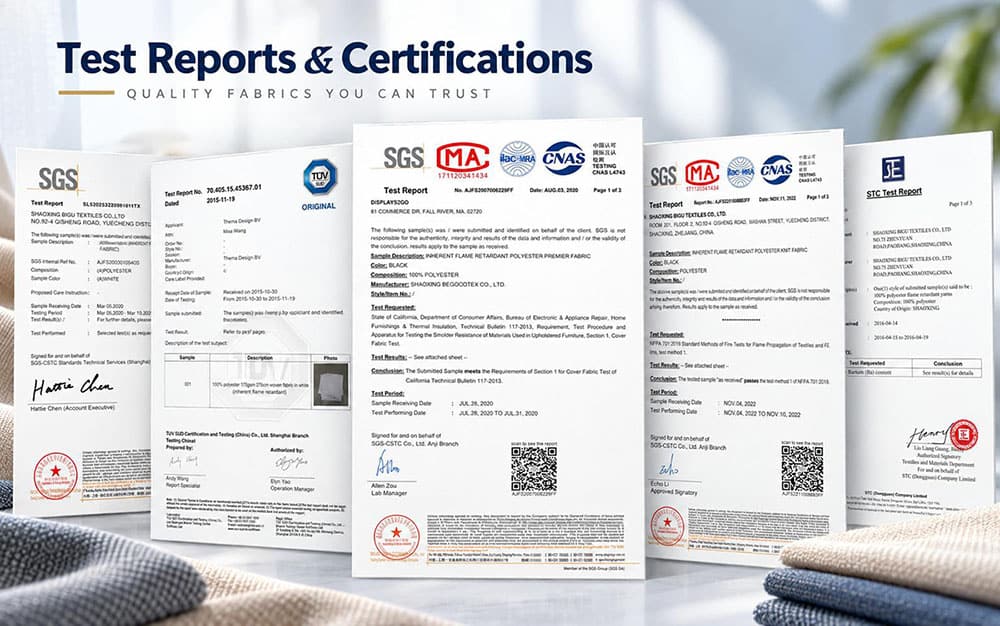
In simple terms, a test document should clearly answer one question: which exact fabric was tested?
If the tested sample differs materially from the product being sourced in composition, weight, construction, or finishing, an authentic report should not automatically be assumed to represent the bulk goods.
Another important issue in FR projects is sample-to-bulk consistency. If composition, weight, construction, or finishing changes between the tested sample, the customer-approved sample, and bulk production, the original test result may no longer represent the final goods accurately.
Product Specification → Tested Sample → Approved Sample → Bulk Production → Final Delivery
This provides more meaningful project assurance than simply holding an FR certificate.
From 2027 onward, EU buyers will pay more attention to two practical questions: where was the product made, and can the supply-chain information be verified?
The EU Forced Labour Regulation (Regulation (EU) 2024/3015) applies from 14 December 2027. It prohibits products made with forced labour from being placed or made available on the EU market.
For textile sourcing, this makes production locations, key processing stages, supplier identity, and appropriate source records more relevant.
This does not mean every sourcing project needs a complex supply-chain investigation. It does mean that suppliers should be able to explain where a product is made, who performs the key production stages, whether critical records can be traced, and whether significant supply-chain changes can be identified in time.
For long-term programs and larger buyers, this information is moving closer to normal supplier qualification.
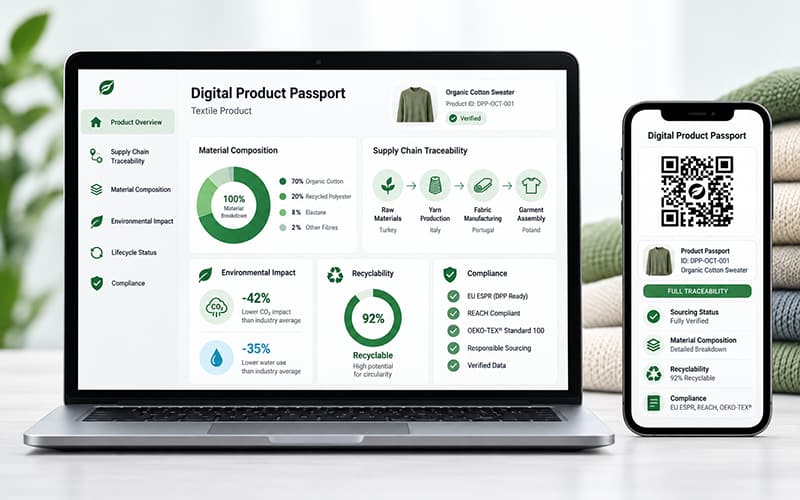
DPP stands for Digital Product Passport. In simple terms, it is a digital information record linked to a product and designed to organize product identity, composition, production, testing, certification, and other relevant data.
The EU has placed textiles and apparel among the priority product groups under the ESPR 2025–2030 Working Plan, with further textile-related rulemaking planned around 2027.
This does not mean that every textile product in the EU must already carry a DPP in 2027. Detailed textile-specific DPP requirements and implementation dates still depend on subsequent product-specific rules. The European Commission also maintains a dedicated Digital Product Passport page for textiles and apparel.
For global buyers today, the more practical issue is whether a supplier can consistently organize product information, composition data, test reports, certifications, production information, and batch records.
As product-data requirements become more structured, a supplier that can only search for scattered PDFs after a customer asks may struggle to support larger sourcing programs efficiently.
Flame performance is not the only compliance dimension that may matter for functional textiles. For fabrics that also use water-repellent, stain-resistant, oil-repellent, or other functional finishes, chemical requirements deserve separate attention.
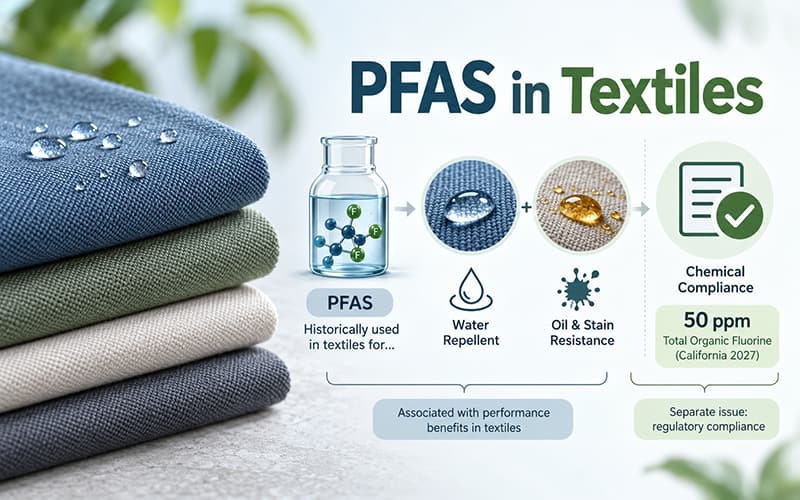
PFAS is a broad group of fluorinated chemicals, some of which have historically been used to provide water, oil, and stain resistance.
California AB 1817 restricts regulated PFAS in relevant textile articles. According to California regulatory information, the total organic fluorine threshold moves from 100 ppm in 2025 to 50 ppm in 2027. See the California DTSC legislative mandate information.
For FR fabric sourcing, the key point is simple: passing a flame test does not by itself demonstrate compliance with PFAS or other chemical requirements.
The same project may therefore require separate review of Fire Performance Compliance and Chemical Compliance. This is especially important when sourcing multifunctional fabrics that combine FR performance with water-repellent, stain-resistant, or similar finishes.
The same principle applies when comparing inherent FR and treated FR fabrics: buyers should consider actual test evidence, care durability, finishing systems, and destination-market requirements rather than relying on the labels “Inherent” or “Treated” alone.
For FR projects that require third-party testing, customer approval, or specified compliance documents, “production complete” does not always mean “ready to ship.”
Testing slots, report issuance, customer confirmation, and document preparation can all affect final delivery.
Traditional production lead time mainly measures how long manufacturing takes.
Compliance-ready lead time looks at the full period from specification confirmation until both the goods and the required test reports or compliance documents are ready for delivery.
For project-based FR fabric sourcing, this can be more useful than production days alone. If testing requirements are defined only after bulk production is complete, a project may still be delayed by retesting, missing documents, or a mismatch between the required and completed test scope.
Confirming standards, third-party testing requirements, and documentation needs at the RFQ and sampling stages can therefore reduce avoidable delivery risk.
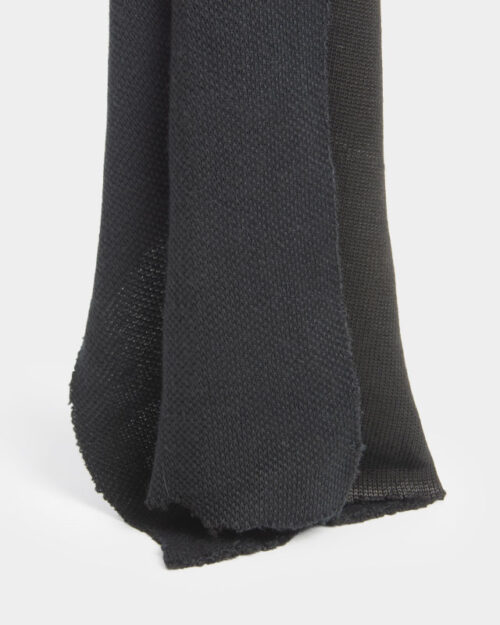 Inherent Flame Retardant Heavy Duty Fabric for Protective Workwear & Correctional Uniforms | 380 g/m² | 150 cm | EN ISO 11612
 Fireproof Double-Sided Oxidized PAN Fabric for Heat Protection | 410 g/m² | 150 cm
 Inherent Flame Retardant Polyester Satin Dimout Curtain Fabric for Hospitality Interiors | 230 g/m² | 220/280 cm | NFPA 701
BEGOODTEX does not treat these changes simply as a reason to collect more certificates. The focus is on keeping product specifications, test evidence, and bulk production aligned.
At the start of a project, the destination market, end use, and required standard are confirmed first. After sample approval, key specifications such as composition, weight, width, fabric construction, and relevant finishing are defined more clearly.
Where third-party testing is required, the testing scope is preferably confirmed before bulk production rather than added after the goods are finished.
Requirement Review → Sample Approval → Specification Freeze → Bulk Production → Internal Pre-Check → Third-Party Testing if Required → Shipment Documents & Traceability Records
The purpose is not to add unnecessary steps. It is to keep the final goods, test evidence, and order specification connected.
As buyers request more product-level information, supply-chain records, and project documentation, this approach also makes it easier to organize test reports, certifications, batch records, and production-related information.
Planning a 2027 flame-retardant textile project? Share the destination market, end use, required standard, quantity, and target specification with BEGOODTEX so the product fit, testing needs, and documentation requirements can be reviewed earlier in the sourcing process.
Not necessarily. Buyers still need to confirm that the tested composition, weight, construction, and other key specifications match the current order.
Not always. If the color change affects the dye system, dyeing chemistry, or key finishing conditions, the representativeness of the existing result should be reviewed.
No. 2027 is an important rulemaking milestone for textiles, but detailed DPP requirements and implementation dates still depend on subsequent product-specific rules.
No. Flame performance and PFAS or other chemical requirements are separate compliance dimensions and should be verified according to the product and destination market.
Significant changes in composition, weight, construction, FR system, or key finishing processes should trigger a review of whether the existing report still applies.