Enter your details and we will send the requested document to your inbox.





Introduction and Background: The Core Barrier of Safety Protection
In the industrial, home, and public space sectors, flame-retardant (FR) fabric is an indispensable part of building safety defenses. However, faced with complex fire standards and technical terms on the market, many professionals often encounter confusion:
A high-quality FR fabric does not passively wait for the flame to extinguish; it is a “built-in defense” firewall from the molecular level. Its core value lies in “delaying danger and gaining time”. This article aims to provide an authoritative and practical guide for selecting FR fabrics across three dimensions: principle analysis, technical durability, and scientific selection, helping you easily determine the reliability and long-term protective capability of a fabric.

Core Comparison: Traditional vs. Durable Flame Retardant Fabrics
| Feature | Traditional Post-Finishing FR Fabric | BEGOODTEX Permanent FR Fiber |
| FR Mechanism | Relies on surface coating or impregnating agents | FR components form covalent bonds with the fiber |
| Wash Durability | Performance sharply declines with washing cycles | Maintains NFPA 701 self-extinguishing performance after 50 industrial washes |
| Performance Stability | High risk of localized peeling | Uniform structure design; FR components are evenly distributed inside the fiber |
| Environmental Focus | Some contain halogens or formaldehyde | Uses halogen-free, low-smoke system, balancing environmental protection and safety |
Here are 5 key technical points for understanding and selecting reliable flame-retardant fabrics:
Fire production relies on three essential elements: heat, oxygen, and fuel. The function of FR fabric is to create a “breakpoint” among these three when exposed to flame, thereby achieving the ability of automatic self-extinguishing.
| Protection Mechanism | Working Principle | Effect and Function | Supplementary Knowledge |
| 1. Heat Absorption & Cooling | FR components decompose and release heat-absorbing substances, consuming thermal energy. | Lowers the temperature, delaying ignition. | Cooling is a prerequisite for stopping the combustion chain reaction, preventing the temperature from sustaining the critical point needed for burning. |
| 2. Inert Gas Dilution | Releases inert gases such as CO2 and N2. | Dilutes oxygen, suppressing combustion. | Oxygen concentration in the air is about 21%. When the oxygen concentration is diluted below a certain level (corresponding to the LOI value), the flame cannot be sustained. |
| 3. Char Layer Formation | A char film is generated on the fabric surface. | Isolates heat and air. | The char layer is one of the most important hallmarks of FR fabric, effectively preventing melting and dripping. |
| 4. Free Radical Capture | Captures combustion free radicals H· and OH· | Interrupts the combustion chain reaction. | Free radical capture is key to the action of the flame retardant, thoroughly “extinguishing” the flame at the molecular level. |
When exposed to flame, a high-quality FR fabric undergoes a complete self-rescue process. This self-rescue sequence is:
The key criterion is that the fabric should not only avoid melting and dripping but also completely self-extinguish within 1–2 seconds after the flame is removed.
The value of FR protection lies in its “durability”. Traditional post-finished fabrics decay quickly because the flame retardant is merely a coating. Leading brands like BEGOODTEX innovate to integrate FR performance into the “fabric’s genes,” ensuring long-term effectiveness.

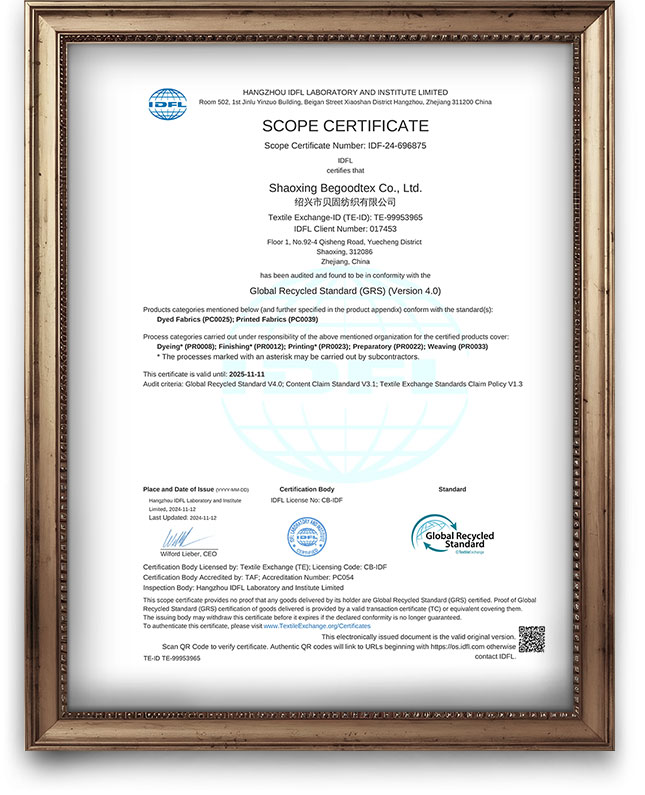
All Begoodtex fabrics and products comply with major global flame-retardant standards, ensuring reliable fire-safety performance across various real-world applications.
Among them, the Begoodtex blackout fabric was tested by the international authority SGS in accordance with the U.S. NFPA 701:2019 (Method 1) standard.
The summarized test results are shown below:
The fabric has successfully passed the SGS test according to NFPA 701:2019 (Method 1) standard.
Results indicate that the sample exhibited no after-flame and no continuous burning after flame exposure, with an average floor-burning time of 1.6 seconds and an average mass loss of 17.91 %, both well below the limits required by the standard.
The material demonstrates excellent self-extinguishing stability and safety performance.
Conclusion: Complies with NFPA 701:2019 flame-retardant requirements.
Testing Laboratory: SGS-CSTC Co., Ltd. (Anji Branch)
Report No.: AJFS2011009764FF
Test Standard: NFPA 701:2019 (Method 1)
| Item | Result | Requirement | Remark |
|---|---|---|---|
| Average Mass Loss | 17.91 % | ≤ 40 % (limit) | ✅ Pass |
| Average Floor-Burning Time | 1.6 s | ≤ 2 s (limit) | ✅ Pass |
| After-flame Time | 0 s | No continuous burning | ✅ Pass |
| Vigorousness of Burning | None | — | ✅ |
| Molten Dripping | Yes | No re-ignition observed | ✅ |
| Odor / Smoke | Slight smoke | — | — |
| Overall Conclusion | Pass | Meets NFPA 701:2019 requirements | ✅ |
With rising health and regulatory requirements, green FR fabric has become a trend. It achieves a value upgrade of low-smoke, non-toxic, and sustainable while maintaining excellent fire performance.
Translating technical knowledge into actionable selection steps is crucial.

Match the selection based on project needs:
Professional selection must be evidence-based, focusing on the following metrics:
| Key Metric | Definition | Significance for Selection |
| LOI Value (Limited Oxygen Index) | The minimum percentage of oxygen concentration required to sustain the candle-like combustion of the material. | A higher LOI value indicates greater fire resistance. Since atmospheric oxygen is about 21%, materials with LOI greater than or equal to 26 (or 27) are generally considered to have self-extinguishing or flame-resistant properties. |
| Char Time | The time required to form the char layer; the shorter, the better. | Reflects the speed at which the fabric forms the thermal isolation barrier to suppress flame spread. |
| Wash Durability | The number of industrial washes the performance can sustain. | Measures whether the FR performance is “permanent,” ensuring long-term protection. |
Recommended Fabric Types for Different Scenarios
| Scenario | Recommended Fabric Type | Key Characteristics |
| Hotels/Theaters | IFR Polyester (Intrinsic FR) | Good drape, durable, low maintenance |
| Medical Apparel | FR Cotton / Green FR | Skin-friendly, breathable |
| Industrial Protection | Aramid / Modacrylic Blend | High strength, high-temperature resistance |
A: Ordinary post-finished types will gradually lose effectiveness. However, BEGOODTEX permanent FR fibers maintain stable performance even after 50 industrial washes.
A: No. BEGOODTEX uses a halogen-free, low-smoke system, and the fire protection effect is comparable to or even better than traditional FR.
A: For public spaces, NFPA 701 or higher is recommended. For industrial protection, EN ISO 11612 is recommended. BEGOODTEX can provide multi-level solutions.
A: No. BEGOODTEX’s blended design ensures softness and breathability, similar to ordinary cotton fabric.
A: A higher LOI value (Limited Oxygen Index) means better fire resistance. Generally, materials with an LOI value of 26% or 27% and above are considered to have sufficient self-extinguishing and flame-resistant properties.
The significance of superior FR fabric extends beyond “fire prevention”; it is about “delaying danger and gaining time”. If you are facing challenges in selecting FR fabrics that meet high standards, durability, or green environmental requirements, contact the BEGOODTEX professional team immediately. We provide multi-level FR solutions based on scientific structure, sustainable concepts, and authoritative verification, ensuring your protection and comfort are both achieved.
Click to consult and obtain exclusive industry solutions and technical data support.