Enter your details and we will send the requested document to your inbox.





If you buy, specify, or wear flame-retardant protective clothing, you have probably been asked point-blank: “But is that stuff actually safe to put on your skin for a 12-hour shift?” It is a fair question. For decades the words “fire-resistant” sat uneasily next to “non-toxic,” and plenty of buyers quietly assumed the two could never share the same garment.
In high-risk industries — firefighting, metallurgy, rail, oil and gas — flame-retardant protective clothing is the first line of defense against burns. The good news: in the last 15 years, materials science has quietly closed the gap. The chemicals that earned retardants a toxic reputation, halogen compounds such as PBDE and TDCPP, have been pulled from most markets. What replaced them — phosphorus–nitrogen chemistry and inherent flame-resistant fibers — do the job without coating the skin in suspect chemicals.
This article walks the full lifecycle of a flame-retardant garment — from the polymer molecule to the test lab — so you can spec with confidence instead of fear. To see how FR garments deliver protection across industries, explore our guide to flame-retardant fabrics for protection.
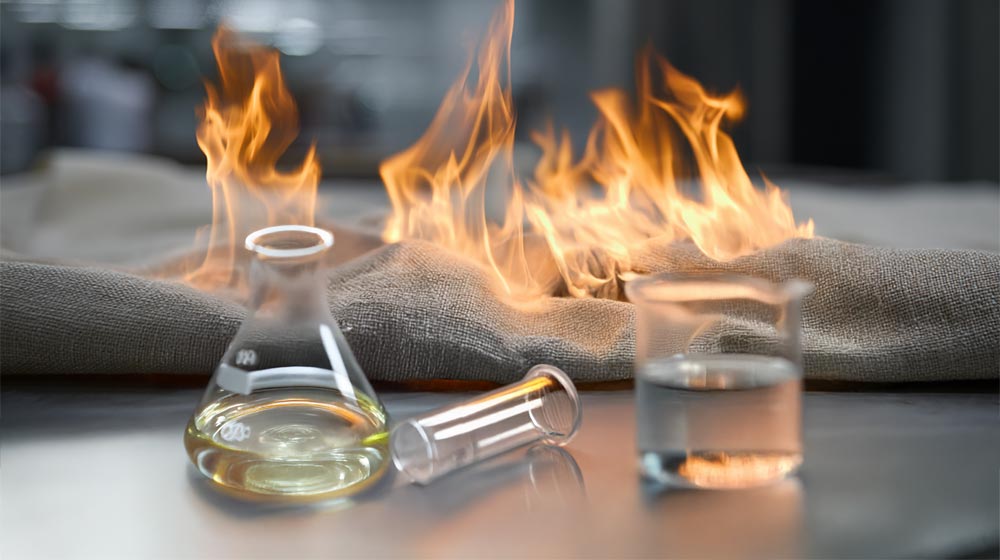
When you evaluate flame-retardant protective clothing, there are only two ways to make a fabric resist fire: build the resistance into the fiber from birth, or add it later as a finish. The health story differs, so know which you are buying.
IFR fibers are born flame-resistant. The retardant elements — usually phosphorus, nitrogen, or stable aromatic rings — are locked into the polymer chain while the fiber is still being synthesized. There is no coating, nothing on the surface to rub off onto skin or wash down the drain.
When these fibers meet a flame they do not melt and drip the way untreated polyester does. Instead they char quickly, building a black crust that starves the fire of heat and oxygen. Common IFR fibers you will see on a spec sheet:
The upside is permanent: the resistance will not wash out, the fiber is odorless and non-toxic, and when it finally burns it releases mostly CO₂ and water vapor. Low toxicity, low drama.
FR-treated fabrics start life as ordinary cotton, polyester, or blends, then gain flame resistance through a chemical finishing process that bonds retardant chemistry to the fiber. Two systems dominate the market:
The appeal is cost. You can turn commodity cotton into certified FR workwear at a fraction of the price of aramid. The catch is quality control. A poorly run finish, or one built on halogenated chemistry, can leave residues that irritate skin or release acrid smoke. Done right and certified, though, these systems are safe for daily wear. If you are choosing between the two routes for your team, our comparison of inherent vs treated FR fabrics breaks down the trade-offs in plain terms.
Here is how the two routes stack up:
| Attribute | Inherent FR (IFR) | FR-Treated |
|---|---|---|
| Source of resistance | Built into the polymer chain | Added as a surface or fiber finish |
| Wash durability | Permanent (life of garment) | 50–100+ industrial washes (system-dependent) |
| Chemical residue risk | None (no free chemicals) | Low when certified; higher with poor finishes |
| Eco-safety | High; minimal hazardous emissions | High when halogen-free and certified |
| Relative cost | Higher | Lower to moderate |
| Typical applications | Turnout gear, arc flash, premium workwear | Cotton workwear, uniforms, budget programs |
To understand why “FR” got a bad name, you have to look at what we used to pour into fabrics.
Mid-20th-century flame retardancy leaned hard on halogens — chlorine and bromine compounds. When halogenated fabrics burned they gave off thick, corrosive, often carcinogenic smoke, and the retardants lingered as persistent pollutants in soil, water, and human tissue. PBDEs, HBCD, and TDCPP became the poster children for the problem.
The backlash was specific: in the late 1970s US regulators pulled tris(2,3-dibromopropyl) phosphate (“Tris-BP”) from children’s sleepwear after it tested as a mutagen. Decades later, PBDEs were restricted across the EU under the POPs Regulation, and several US states banned them outright. The lesson buyers carried forward was simple: halogen-free is the safer default. The chemical-restriction framework behind this is enforced through EU REACH and similar national rules.
Today the industry has moved to three cleaner families. Here is the map:
| Chemistry family | How it works | Safety verdict |
|---|---|---|
| Halogen-based (PBDE, TDCPP, HBCD) | Releases flame-suppressing radicals, but toxic smoke | Phased out / restricted — avoid |
| Phosphorus–nitrogen | Char-forming; cools and shields the surface | Low smoke, skin-safe when certified |
| Inorganic (ATH, MDH) | Releases water vapor under heat, dilutes the flame | Very low hazard; needs high filler load |
| Nitrogen-based (melamine) | Intumescent char expansion | Low hazard, good for blends |
| Inherent polymer structure | Resistance is part of the molecule | Safest class; nothing to leach |
See the five leading FR fabric materials driving this shift to safer chemistry.
Both phosphorus–nitrogen and inorganic systems are genuinely low-hazard, but they behave differently on the line and on the body — and that affects what you should specify.
Phosphorus–nitrogen finishes (Pyrovatex®-style) char the fiber into a protective crust, keep a cotton-like hand feel, and survive repeated washing. The trade-off is chemistry management: the finish must be applied and cured correctly, and it has a defined wash life, not a permanent one.
Inorganic systems use minerals — aluminum trihydrate (ATH) or magnesium dihydroxide (MDH). Heated, they release water vapor that cools the fabric and smothers the flame with steam. Little burns or emits, and the mechanism never “wears out” like a finish. The catch is load: 30–60% filler by weight is typical to hit the same rating, making the fabric heavier, stiffer, and rougher — so ATH and MDH appear more in non-woven barriers and panels than in next-to-skin workwear.
For buyers, the rule of thumb is: want soft and wash-durable for daily wear? Phosphorus–nitrogen or IFR. Want maximum inert safety in a stationary barrier? Inorganic mineral fill is hard to beat.
The honest answer to “is it toxic?” comes down to one word: compliance. A certified garment worn for years is not the same as a cheap uncertified one. Let us separate the two.
Because there are no free chemicals to begin with, IFR fabrics have the cleanest long-term profile:
FR-treated garments are safe when built on certified phosphorus–nitrogen chemistry such as Pyrovatex®, tested to OEKO-TEX® and GB 18401 limits. The risk lives at the bottom of the market: uncertified finishes can carry residual formaldehyde or hidden halogens that cause skin or respiratory irritation over months of wear. Care matters too — learn how to wash FR clothes without stripping protection or mobilizing residues.
A compliance checklist worth keeping at your desk:
| Checkpoint | Limit to look for | Why it matters |
|---|---|---|
| Formaldehyde | ≤ 75 ppm (Class II) | Skin and airway irritant |
| Aromatic amines | Not detected (≤ 20 mg/kg) | Carcinogen control |
| pH value | 4.0–7.5 (skin contact) | Prevents dermatitis |
| Smoke toxicity | Per ISO 11612 / rail specs | Protects wearers and rescuers |
| Heat transfer | Within EN ISO 11612 limits | Second-degree burn threshold |
| After-flame / char length | Per GB/T 8965.1 | Confirms the FR actually works |
Anyone can print “flame resistant” on a tag. Standards are what stop the bluffing. Here is the map buyers actually use:
| What it proves | Standard | Who it matters to |
|---|---|---|
| Flame and heat resistance | ISO 11612 | Global industrial wearers |
| Flash fire protection | NFPA 2112 | Oil & gas, US market |
| Chemical safety of textiles | OEKO-TEX® Standard 100 | Anyone touching skin |
| General safety (China) | GB 18401 | China supply chain |
| Protective clothing base | EN ISO 13688 | European specifiers |
| FR performance (China) | GB/T 8965.1 | Chinese workwear programs |
A garment that passes ISO 11612 and OEKO-TEX® guarantees both fire protection and human safety. Browse our complete flame-retardant fabric range engineered to these specifications.
Begoodtex® takes the IFR idea one step further. Rather than treating a finished fabric, the brand builds phosphorus–nitrogen retardant units directly into the polyester polymer chain during spinning. The result is a fiber where safety, hand feel, and recyclability are designed in together, not bolted on after.
In practice that means garments rated for 500+ wash cycles, certified to OEKO-TEX® Standard 100 Class II, GRS (recycled content), and ISO 9001 for process control. For a buyer, the pitch is not “buy our magic chemical” — it is “the safety is in the molecule, so it cannot wash away.”
Here is the shortlist we give procurement teams:
For a deeper procurement lens, see our flame-retardant fabric selection guide.
Even a clean garment can go wrong in the wash. A few rules keep the safety intact and the residues low:
A safety manager at a Midwest metal foundry told us his turning point came after a near-miss. An operator’s older, halogen-finished shirt released a sharp chemical smell during a small splash fire; nobody was hurt, but three workers filed irritation reports. The plant re-specced to an IFR modacrylic/cotton blend the next quarter. “We stopped arguing about chemistry,” he said, “and just bought the thing with nothing to off-gas.” That is the whole thesis in one sentence.
Not when they are certified. Modern flame-retardant protective clothing built on inherent fibers or phosphorus–nitrogen chemistry, and tested to OEKO-TEX® Standard 100, is safe for long-term skin contact. The toxic reputation comes from old halogenated chemistry that is now restricted.
The flagged ones are halogen-based: PBDE, TDCPP, HBCD, and Tris-BP. They have been phased out or restricted under REACH, the EU POPs Regulation, and various national rules because of carcinogenic or persistent-pollutant concerns.
Ask for the full test report, not a summary. Check for OEKO-TEX® Standard 100 (with a class number), REACH SVHC clearance, and a named lab. Confirm the retardant family is halogen-free or inherent.
IFR fibers keep their resistance for the life of the garment. FR-treated fabrics are rated for a set wash count, often 50–100+ industrial cycles. Track laundering and retire at the limit.
OEKO-TEX® Standard 100 Class II, GRS for recycled content, and ISO 9001 for quality management, with FR performance built into the fiber molecule.
Yes. Certified flame-retardant protective clothing to OEKO-TEX® Class II/III and GB 18401 is cleared for direct skin contact. Base layers and firefighter underwear are commonly IFR for this reason.
For children and baby products, OEKO-TEX® Class I is the stricter bar; IFR and certified phosphorus–nitrogen systems meet it. Pregnant workers face no added risk from compliant FR garments, but normal occupational-hygiene rules still apply.
“Flame-resistant” and “non-toxic” stopped being opposites somewhere in the last decade. The chemistry that earned flame-retardant protective clothing its bad name is gone from compliant supply chains, replaced by inherent fibers and phosphorus–nitrogen systems that protect without poisoning the wearer. Your job as a buyer is simple: specify halogen-free, demand the certificate with a class number, and match the standard to your market.
DIN 5510 / BS 6853 / NES 713 — Railway rolling stock fire safety (smoke toxicity).
ISO 11612:2015 — Protective clothing against heat and flame.
OEKO-TEX® Standard 100 — Product class limits for skin contact.
EU REACH Regulation (EC) No 1907/2006 — SVHC screening.
NFPA 2112:2018 — Standard on flame-resistant garments for flash fire.
GB 18401 — National general safety technical code for textiles (China).
EU POPs Regulation (EC) No 850/2004 — restriction of PBDE, HBCD, and related substances.