Enter your details and we will send the requested document to your inbox.





In international textile trade, when a buyer from Europe, Australia, or the Middle East asks, “How many abrasion cycles does this fabric have?” they are almost always referring to ISO 12947-2. This international standard defines how many friction cycles a textile withstands on the Martindale instrument before it shows breakdown. For furniture and contract-fabric exporters, it is the single most-quoted “health check” on the spec sheet — and misreading it can sink a tender.
Quick answer: ISO 12947-2 is the international standard that measures fabric abrasion resistance with the Martindale tester, counting friction cycles until the specimen breaks down. Residential fabrics typically need 15,000–25,000 cycles; commercial contract fabrics target 30,000–50,000+ cycles at 12 kPa pressure.
ISO 12947 is a four-part series published by the International Organization for Standardization to unify abrasion testing worldwide. Part 2 — Determination of specimen breakdown — is the part buyers actually cite; in nine out of ten commercial contracts, quoting ISO 12947-2 is enough, because the other parts only cover apparatus, mass loss, and appearance change.
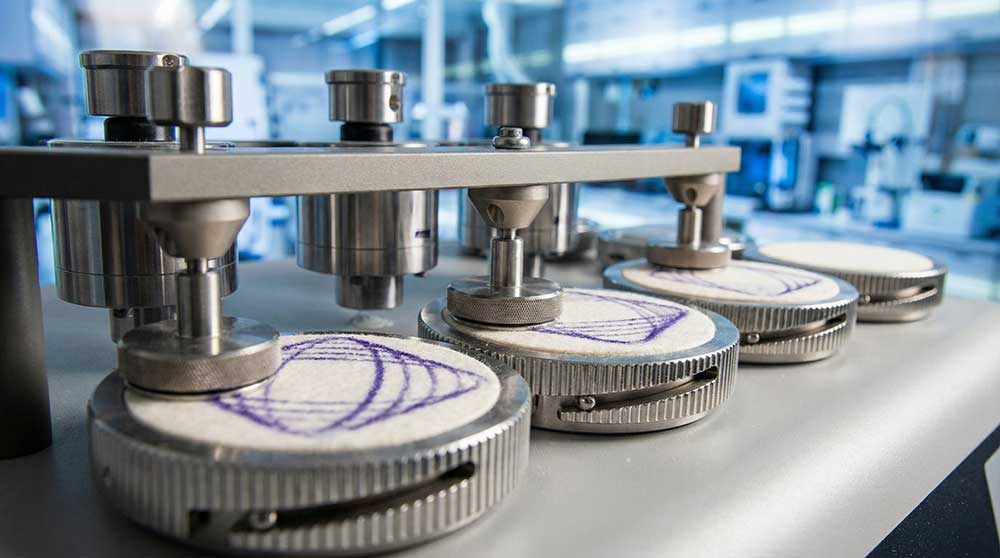
The test uses a Lissajous-figure trajectory for multi-directional rubbing. A circular specimen is clamped to a holder and rubbed against a standard wool abradant under set pressure. The motion widens from a circle to an ellipse and back to a line, then repeats, so both warp and weft yarns wear evenly. That even wear is exactly why the Martindale number is trusted over any single-direction method.
The standard applies to almost every textile type:
For pile fabrics, if the pile wears off but the base cloth still holds, the test still ends — the surface has lost its commercial value even though the cloth did not fail.
ISO 12947-2 reports a raw cycle count; it does not itself set a “pass” line. Grading usually follows application standards such as BS 2543 or EN 14465. The bands below are the industry norm buyers quote back to you:
| Performance level | Recommended cycles (ISO 12947-2) | Typical use |
| Decorative | < 10,000 | Throw pillows, display chairs |
| Light use | 10,000–15,000 | Bedroom furniture, occasional chairs |
| General domestic | 15,000–25,000 | Daily-use living-room sofas |
| Severe domestic | 25,000–30,000 | Homes with children and pets |
| Contract | 30,000–40,000 | Offices, hotel guest rooms |
| Severe contract | ≥ 50,000 | Airports, hospitals, transit seating |
When you specify contract-grade sofa fabrics, match the cycle band to the traffic the piece will actually see — not to how it looks on the showroom turntable.
The method is strict, and two details decide whether a number is valid enough to ship against.
For the full picture of how flame-retardant textile testing is run alongside abrasion checks, our testing guide walks through each station step by step.
Both ISO 12947-2 and ASTM D4966 use the Martindale instrument, so equipment, principle, and pressure parameters are nearly identical. The real difference is geography: ISO is the global language, while ASTM is the US-family version, technically equivalent to China’s GB/T 21196.2. Quote ISO for Europe, Australia, Asia, and the Middle East; quote ASTM only when a US client explicitly asks for “Martindale” data in that format.
Wyzenbeek is a different animal entirely — bi-directional linear rub against cotton duck or wire mesh, measured in double rubs. There is no fixed conversion between the two. Some chenille upholstery runs 20,000 Martindale cycles but 100,000 Wyzenbeek double rubs; certain coated fabrics flip the ratio the other way. Test each method separately for its target market and never attempt a换算.
Procurement teams bake cycle minimums directly into purchase orders:
These thresholds sit alongside the EU, US, and China flammability testing standards a supplier must also clear before a contract fabric ships.
A high Martindale number is built into the material, not added at inspection:
BEGOODTEX engineers to these rules for high-traffic areas. For extreme transit and airport seating we use high-tenacity modified nylon or special polyester blends that exceed 100,000 cycles at 12 kPa — see our 100,000-cycle abrasion-resistant upholstery fabric. For velvet we apply a “W-type” pile-anchor weave that tops 50,000 cycles while keeping the luxury hand. The same logic applies when choosing a fire-retardant upholstery fabric for contract projects where both wear and fire codes apply.
 Flame Retardant Blue PET Nonwoven Fabric for Contract Hospital and Clinic Projects | 60/80/100 g/m² | 150 cm | BS 5867 Type C
 Flame Resistant Black Workwear Fabric with Aramid for OEM Programs and International Project Sourcing | 185 g/m² | 150 cm | EN ISO 11612
 Flame Resistant Aramid Modacrylic Protective Clothing Fabric from a China Textile Mill | 210 g/m² | 150 cm | EN ISO 11612
Two traps trip up even experienced buyers.
Yes — identical. China’s GB/T 21196.2 is “IDT” (identical) to ISO 12947-2, so certified Chinese-lab reports are recognized internationally because the technical parameters match exactly.
Labs stop once a fabric passes the client’s required threshold, to save testing time and cost. “Greater than 50,000” already signals excellent quality and is accepted by most specifiers.
Yes for thick coated goods such as PU leather, but watch coating peel — if the coating wears off first, that point is treated as the test endpoint.
No reliable formula exists; the ratios swing widely by fiber and coating. Test each method for its own market rather than converting.
Always 12 kPa (795 g). A 9 kPa result may look better on paper but is rejected by furniture specifiers who understand sitting load.
ISO 12947-2 is the universal language of fabric abrasion resistance, and the Martindale cycle count it produces is the number that wins or loses tenders. Read the pressure, match the cycle band to the traffic, and engineer durability into the fiber and weave from the start. Browse the full range of flame-retardant fabric solutions, or contact our team for OEM specification support.
For the official source text and version history, see the ISO 12947 standard family.