Enter your details and we will send the requested document to your inbox.





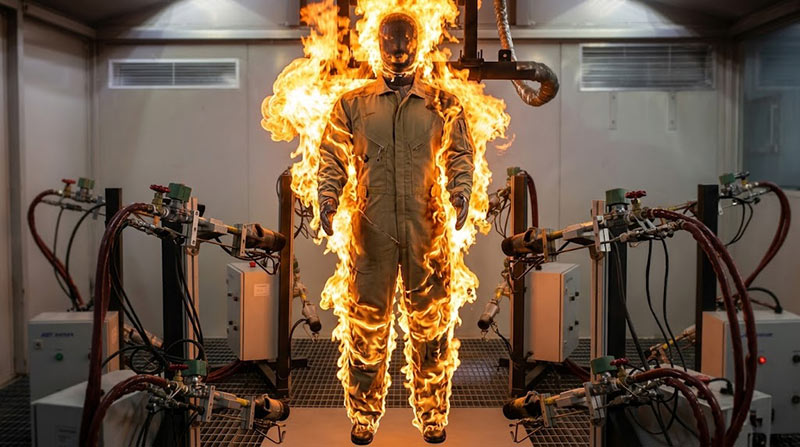
ASTM F1930 is an internationally recognized test method, not a performance standard. It establishes a procedure for evaluating complete protective clothing systems—such as coveralls, lab coats, and other protective garments—using a life-sized instrumented manikin equipped with sophisticated heat sensors. The official title of the standard is:
“Standard Test Method for Evaluation of Flame-Resistant Clothing for Protection Against Flash Fire Simulations Using an Instrumented Manikin.”
Unlike many flame-resistance tests that evaluate only small fabric specimens, such as vertical flame tests, ASTM F1930 focuses on the real-world performance of an entire garment system. This distinction is critical because even when the fabric itself performs well, design flaws in the garment can significantly reduce overall protection. For example, loose cuffs, exposed metal zippers, or seams that fail under high temperatures may allow heat and flames to penetrate more easily. Manikin testing provides a more realistic assessment of how a complete garment performs when exposed to a short-duration flash fire.
The primary objective of ASTM F1930 is to predict the extent of burn injuries that a wearer may suffer. During the test, the sensors measure the amount of heat transmitted through the clothing, and specialized software uses this data to calculate the percentage of the body that could sustain second-degree or third-degree burns in a simulated flash-fire event.
By analyzing these results, manufacturers can improve fabric formulations, garment construction, and design details, ultimately enhancing the overall protective performance of flame-resistant clothing.
ASTM F1930 and NFPA 2112 are really different.
ASTM F1930 is like a guide that tells you how to do a manikin test. It explains how you should record the data and how you calculate the predicted burn injury.
NFPA 2112 is a standard, for clothing. It says what garments have to be able to do. For example if there is a flash fire the clothing has to keep the body burn to a level.
So when someone says they tested something using ASTM F1930 that is not information.
You still need to know some things, like:
Small fabric tests are useful.
They can show if a fabric keeps burning, chars, melts, drips or gets smaller when on fire.
A small piece of fabric is not like a real garment on the body.
It is a flat piece of material.
A real garment has parts that affect how fire and heat touch the skin.
In life things, like the collar, cuffs and openings of pants, zippers, pockets threads used for sewing and how the garment fits all play a role.
These things change how flame and heat reach the skin.
That is where ASTM F1930 becomes valuable.
It tests the complete clothing system, not just one piece of fabric.
A fabric may perform well by itself, but the finished garment may still have weak points.
For example:
These problems are much easier to see when the whole garment is tested on a manikin.
ASTM F1930 does not use a normal display mannequin.
It uses an instrumented test manikin fitted with many heat sensors across the body, head, arms, and legs. These sensors record how heat reaches different body areas during the flash fire.
In the test, the lab dresses the manikin in the complete flame-resistant garment and exposes it to a controlled fire from burners.
A common heat flux is 84 kW/m², and the exposure time is often 3 or 4 seconds, depending on the test requirement.
The result is not just a simple “pass” or “fail.”
The more useful information is the predicted body burn percentage and the burn injury map.
If the chest area shows heavy burn prediction, the front fabric or placket design may be a problem.
If the wrist or neck area shows higher injury, the cuff or collar closure may not be protective enough.
If burn areas appear around seams, the sewing thread or garment construction may need review.
This burn map is very useful. It helps manufacturers see whether the problem comes from the fabric, garment design, or a small component.
 Anti-Static Flame Resistant Coveralls Cotton Salopette for Contract Safety Garment Production with Custom Production Options | EN ISO 11612
 Anti-Static Fireproof Aramid IIIA Henley Shirt Garments for Protective Clothing with Wholesale and Custom Supply Options | EN ISO 11612
 Anti-Static Flame Resistant Cotton Coverall with Reflective Tape North American Style for Protective Clothing | EN ISO 11612
One of the key numbers in an ASTM F1930 report is TBB, or Total Body Burn.
It shows the predicted percentage of the body that may suffer second-degree or third-degree burns.
In general, the lower the TBB, the better the garment protection.
But this number should not be read alone.
You also need to check how much is second-degree burn and how much is third-degree burn. Third-degree burn is more severe because the injury is deeper.
The burn map also matters. It shows whether the injury is spread across the body or concentrated in critical areas such as the chest, neck, zipper, or cuffs.
For example, two garments may both show 25% TBB.
But one may show mostly scattered second-degree burns, while the other may show serious third-degree burns around the chest and neck.
The real risk is not the same.
So when reviewing the report, do not only ask:
“What is the burn percentage?”
Look at the full report, especially the burn level and burn location.
ASTM F1930 is mainly used where flash fire risk exists.
This includes oil and gas platforms, refineries, petrochemical plants, and similar industrial environments.
Facilities with combustible dust risks, such as grain handling, wood processing, or sugar production, may also pay attention to this type of testing.
Some electrical and utility jobs mainly face arc flash risk, but the worksite may also have flash fire exposure. Military, defense, emergency response, and special industrial jobs may also use manikin testing to understand how a full clothing system performs.
These industries have one thing in common:
The danger comes very fast, and workers have very little time to react.
Protective clothing cannot promise zero injury.
But it can reduce the burn area and the severity of injury.
In flash fire situations, that difference matters a lot.
ASTM F1930 is not a general certificate. It is not a simple fabric test either.
It dresses a complete protective garment on an instrumented manikin, exposes it to a few seconds of simulated flash fire, and shows how much protection the garment may provide to the body.
When reading the report, do not only check whether the test was done.
Look at the exposure time, heat flux, washing history, Total Body Burn, second-degree and third-degree burn percentages, and where the burn map shows the main problem areas.
For oil and gas, petrochemical, combustible dust, and other high-risk industries, these details are much more useful than simply saying “FR clothing.”
A good protective garment does more than stop burning after flame exposure.
It should help reduce heat transfer, garment shrinkage, stored heat injury, and structural failure.
The real goal is to lower burn risk as much as possible.
No. ASTM F1930 is a test method. It explains how to use an instrumented manikin to evaluate the performance of a complete protective garment in a flash fire. Certification requirements are usually set by performance standards such as NFPA 2112.
NFPA 2112 uses ASTM F1930 as part of its testing requirements. Under NFPA 2112, the garment’s predicted total body burn after a 3-second flash fire exposure must not exceed 50%.
Generally, yes. A lower Total Body Burn means a smaller predicted burn area and better garment protection. But buyers should also look at second-degree and third-degree burn percentages and the burn injury map.
In a flash fire, more than the fabric is involved. Collar design, cuffs, zippers, sewing thread, garment fit, air gaps, and inner layers all affect heat transfer. ASTM F1930 evaluates the whole garment system.
Protective clothing is worn and washed repeatedly. A new garment test does not always represent long-term performance. After-wash testing helps show whether the FR performance and garment structure remain durable.
Not always. Thicker fabric may offer better insulation, but comfort, movement, air gap, shrinkage, trims, and garment design also affect the final result. A thicker fabric alone does not guarantee a better manikin test result.