Enter your details and we will send the requested document to your inbox.





BEGOODTEX fire-resistant spandex fabrics are commonly used in tablecloths for their safety features and aesthetic appeal. The flame retardant properties provide a sense of security in dining settings where candles or open flames are used, an element for a cozy ambiance. Additionally, the fabrics’ wrinkle resistance ensures that the tablecloths maintain an appearance during gatherings and events.
When you fit out a theater, a hotel ballroom, or a busy shopping center, the stretch fiber in the chair covers is rarely the first thing on a buyer’s mind. But spandex fabric fire safety is exactly the detail that decides whether a venue passes inspection — or becomes a liability. Spandex shows up wherever soft furnishings need to stretch and recover: table linens, chair covers, stretch slipcovers, and form-fitting protective garments. Left untreated, it is highly flammable. Engineered correctly, it becomes a dependable part of a fire-safe interior. This guide walks procurement teams through how FR spandex works, how it is tested, and where BEGOODTEX specifies it.
Featured Snippet
Spandex fabric is flammable on its own, but fire retardant spandex resists ignition and self-extinguishes through inherent FR fibers or chemical treatment. To verify safety, FR spandex must pass NFPA 701 after 25 wash cycles, retaining protection through repeated laundering.

Large-occupancy venues — theaters, concert halls, shopping malls, event centers — concentrate people and combustibles in the same room. A small ignition source (a candle on a banquet table, a faulty fairy light, a dropped cigarette) can escalate quickly when the surrounding textiles are untreated synthetics. Building and fire codes in most markets therefore require decorative and upholstered fabrics in public spaces to meet a recognized flammability standard before installation.
Spandex is prized in these settings for its elasticity and comfort: stretch covers hug chairs and tables into a crisp, wrinkle-free silhouette that looks intentional even after a full day of use. That same elasticity comes from a polyurethane backbone that is essentially plastic — and plastic burns. Understanding spandex fabric flammability is not academic; it is the difference between a compliant fit-out and a recalled one. Facilities managers and event planners should treat FR certification as a non-negotiable spec line, not a nice-to-have.
Spandex (known as elastane or Lycra® in many markets) is a long-chain synthetic polyurethane fiber prized for extreme stretch — it extends to 5–8 times its relaxed length and snaps back without permanent deformation. That recovery is what gives activewear, shapewear, and stretch furnishings their close, smooth fit.
A few facts buyers should know:
In short, spandex brings comfort and fit; it does not bring fire safety on its own. That safety has to be designed in — which is where flame retardant spandex fabric engineering comes in.
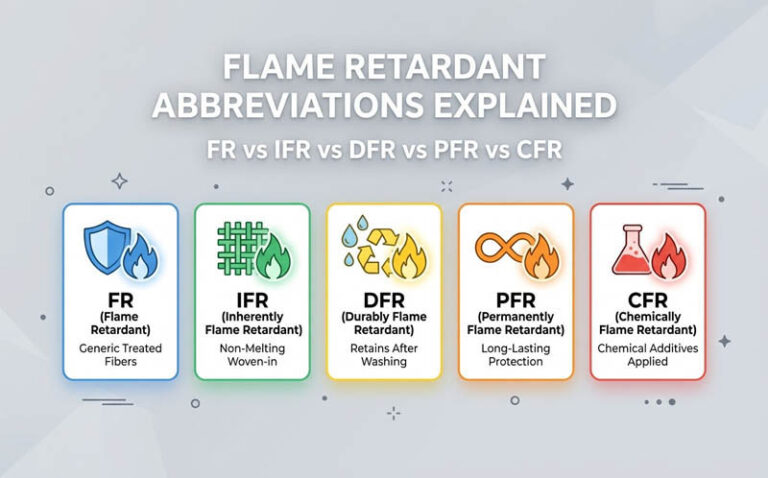
There are two fundamentally different ways to make spandex safer near flame. They are not interchangeable, and the difference matters for how long the protection lasts.
Inherently flame retardant (IFR) protection is built into the polymer at the manufacturing stage. FR elements are integrated into the fiber structure so the fabric resists ignition and slows flame spread as a permanent physical property. In a spandex blend, IFR fibers can be combined with the elastane to raise the whole cloth’s resistance without relying on a surface coating.
The advantage is durability: because the protection is part of the fiber, it does not wash out or wear off. Buyers specifying inherently flame retardant fibers get protection that survives the full service life of the product. For the chemistry behind it, how inherent FR technology works explains the mechanisms BEGOODTEX builds into its IFR lines.
The alternative is a topical treatment: flame retardant chemicals applied to the fabric surface or bonded into the fiber during finishing. Done well, this can lift a flammable cloth to a passing score on first test.
The caveat is longevity. Treatment effectiveness depends on the chemistry used, the application method, and the base fabric composition — and it can decline with repeated washing and abrasion. For low-touch decorative use this may be acceptable; for items laundered often (chair covers, table linens, workwear), inherent protection is the safer long-term bet.
| Approach | How it works | Wash durability | Best for |
| Inherent FR (IFR) | FR built into the fiber polymer | Permanent, survives full life | High-wash items: chair covers, tablecloths, workwear |
| FR chemical treatment | FR applied as surface/finishing treatment | Declines with wash & abrasion | Low-touch decorative use |
 Inherent Flame Retardant Stretch Spandex Chair Skirt Cover for Weddings and Events
 Permanent Flame Resistant Stretch Spandex Table Cover
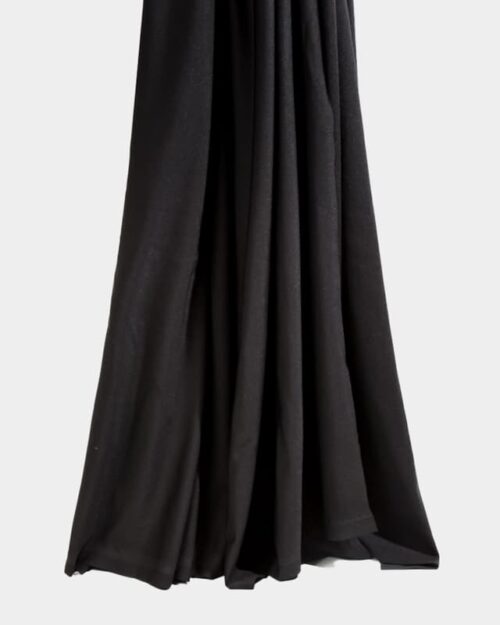 Inherent Flame Retardant Warp Spandex Fabric in Black, Polyester, 320cm Width
In the United States, the reference test for draperies, decorative textiles, and many stretch furnishings is NFPA 701 (Standard Methods of Fire Tests for Flame Propagation of Textiles and Films). The test exposes a conditioned fabric sample to a controlled flame and measures afterflame time and char length — essentially, how long it keeps burning after the source is removed and how far the burn travels.
A critical detail for buyers: NFPA 701 compliance is normally verified after 25 wash cycles. A fabric that passes when new but fails after laundering is not a compliant solution. This is why BEGOODTEX documents FR performance through accredited labs rather than relying on a one-off pass. You can review the full list of NFPA 701 and other textile flammability standards we test against, and our TÜV SÜD third-party FR test reports are available on request.
For context, NFPA 701 is one of several relevant standards:
Spandex-rich furnishings used in public venues should be specified against the standard that applies to their end use and market.

Beyond compliance, FR spandex earns its place in commercial interiors because it solves several buyer problems at once.
FR-engineered spandex contains fibers that naturally deter ignition and slow propagation without added chemicals. Because the protection is inherent, BEGOODTEX flame retardant spandex fabric retains its fire-resistant properties after 25 washes, in line with NFPA 701. That durability removes the “when did the treatment wear off?” guessing game.
Spandex stretches and recovers without losing shape, giving fitted covers a taut, professional look on chairs and tables of slightly different dimensions. The fabric resists wrinkling through repeated use, so event teams spend less time steaming and more time setting up.
The fine, soft filaments blend into the base cloth for a smooth hand feel against skin — important for stretch garments and close-contact furnishings. This comfort is why spandex appears in both activewear and everyday contract textiles where function and feel both matter.
FR spandex holds color through sunlight exposure and frequent washing, so branded or patterned linens stay sharp. That colorfastness supports customization — venues can specify house colors without worrying about premature dulling.
No, and the distinction affects FR strategy. Spandex is a synthetic elastane built for stretch; cotton is a natural cellulose fiber prized for softness and breathability. They are often blended, but their fire behavior differs.
| Property | Spandex | Cotton |
| Fiber type | Synthetic polyurethane elastane | Natural cellulose |
| Stretch | High (5–8× recovery) | Low (unless blended) |
| FR approach | Inherent FR fibers or chemical treatment | FR treatment or FR-rayon blend |
| Best use | Fitted/stretch covers, form garments | Soft, breathable, non-stretch items |
Neither is safe near flame untreated. The practical takeaway: specify the FR route that matches the fiber and the wash load, and verify it against the relevant standard.
BEGOODTEX supplies FR spandex across several contract categories where stretch and safety must coexist.

FR spandex tablecloths combine safety with presentation. In dining rooms, banquet halls, and trade-show booths where candles or open flames are present, the fire retardant tablecloths give planners peace of mind. Wrinkle resistance keeps tables looking set even through long events.
FR chair covers stretch smoothly over mismatched seating for a uniform look, while meeting flammability requirements for event venues, conference centers, and houses of worship. The elastic fit also means fewer sizes to stock.
FR spandex is used in flame retardant workwear where flexibility and a close fit improve safety and mobility. The fiber’s natural resistance paired with inherent FR engineering makes it suitable for garments worn in hazardous environments where ease of movement matters.
Yes — untreated spandex is a thermoplastic polyurethane and will ignite and melt like other synthetics. Fire safety depends on engineering the fabric with inherent FR fibers or an FR treatment, then verifying it against a standard such as NFPA 701.
Two ways: build FR protection into the fiber polymer (inherent/IFR, permanent), or apply an FR chemical treatment during finishing (effective but can decline with washing). For high-wash items like chair covers and tablecloths, inherent protection is the more durable choice.
NFPA 701 is the US standard for flame propagation of textiles and films, measuring afterflame and char length after flame exposure. Compliant FR spandex must pass after 25 wash cycles. BEGOODTEX validates its FR spandex through accredited third-party labs; see the NFPA 701 standard reference for the official method.
Topical FR treatments can lose effectiveness with repeated washing and abrasion, which is why high-wash items should use inherent FR fibers. Inherent protection is part of the fiber itself and does not wash out, retaining NFPA 701 performance through the product’s service life.
Fire safety of spandex fabric comes down to one principle: never assume the stretch fiber is safe on its own — specify and verify the FR route. Inherent FR fibers deliver permanent protection through wash after wash, while chemical treatments suit lower-wash decorative use. Test against the standard that fits the end market (NFPA 701 for US decorative textiles), and source from a supplier that documents third-party results.
BEGOODTEX engineers flame retardant spandex fabric for the venues, hotels, and workwear programs that need stretch and compliance in the same cloth. To discuss specifications, request test reports, or sample a FR spandex line, contact our FR fabric specialists.
Related Reading