Get in touch
Thank you for reaching out! Please tell us more about your needs — our expert team will get back to you within 24 hours.




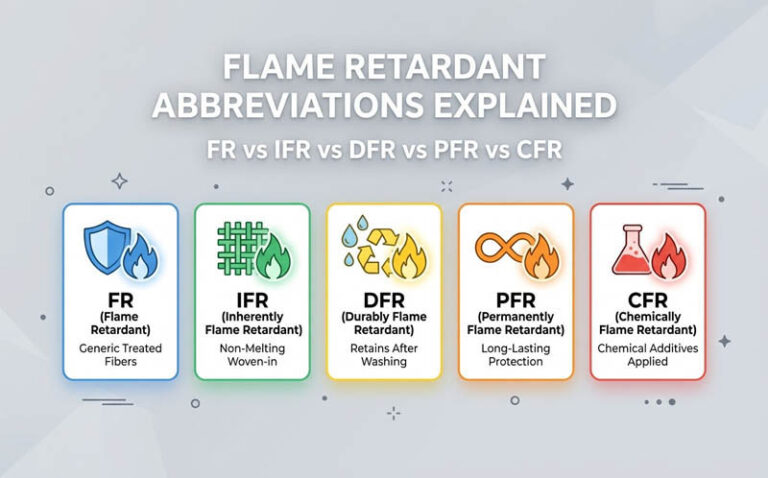
A buyer once told me he skipped FR curtains for a hotel lobby because “they must be hot and stiff.” That assumption cost him a redesign six months later when the fire marshal required compliant drapery. The truth is more useful than the myth: flame-retardant (FR) protection does change how a flame retardant fabric feels and performs — but how much depends entirely on how the protection is built in. When considering options, it’s important to note that flame retardant fabric can vary significantly in comfort.
The short answer: A chemical flame-retardant fabric finish or back-coating generally reduces softness and air permeability somewhat, because the additive sits in or on the fibers. Inherently flame-retardant (IFR) fibers — the principle behind permanent flame-resistant fabric — carry flame resistance in the polymer itself, so hand feel and breathability stay much closer to a conventional flame retardant fabric. Durability follows the same logic: a durable FR finish survives washing and abrasion for a defined number of cycles, while IFR performance does not wash out at all. Before you buy, weigh the FR method against your application: a cruise curtain, a hospital cubicle curtain, and a stage drape each tolerate a different trade-off between compliance, comfort, and lifespan, especially when selecting flame retardant fabric.
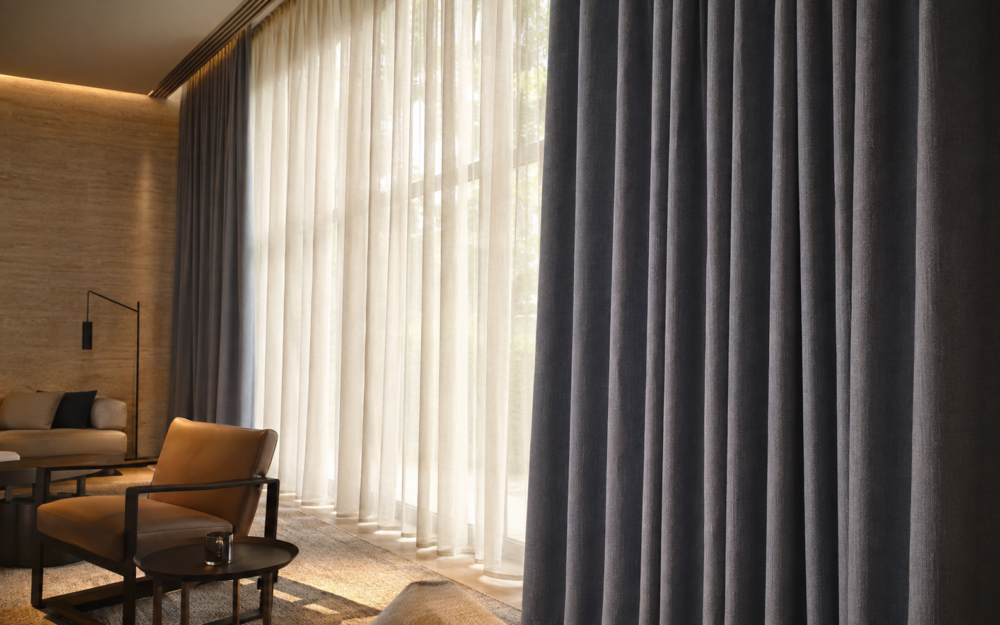
A well-selected flame retardant fabric will not only meet standards but also enhance user experience.
Understanding the properties of flame retardant fabric is essential for making informed choices in various applications.
When choosing textiles, consider how flame retardant fabric will perform in your intended application.
Every FR textile falls into one of two camps, and almost everything about comfort, breathability, and durability follows from which camp it is in.
Chemical FR treatment (finish). A flame retardant is applied to an otherwise conventional fabric — by padding, exhaustion, or coating. Many blackout FR curtains also add a back-coating (a layer on the back that blocks light and carries FR properties). The finish is what makes the fabric flame resistant, but it is also what changes the hand feel: the additive fills gaps between fibers or sits as a film on the surface, and a back-coating is literally an extra layer on top of the cloth.
In any case, understanding flame retardant fabric types can significantly impact your decision-making process.
Choosing the right flame retardant fabric ensures safety without compromising comfort.
IFR (inherently flame retardant) fiber. Here the flame resistance is baked into the fiber during production — think of it as the polymer itself being fire-resistant. There is no after-applied finish to stiffen the cloth, so the fabric behaves much like its non-FR cousin. The resistance cannot be washed or abraded away because it lives inside each fiber. Explore our full range of inherently flame-retardant (IFR) fiber options to see how this plays out across different weaves and weights.
A variety of flame retardant fabric options exist for different applications, allowing for flexibility in design.
This is crucial when dealing with flame retardant fabric intended for high-traffic areas.
Softness in a flame retardant fabric can vary greatly based on its treatment.
Which one to pick? Here is a practical guide:
Understanding the differences in flame retardant fabric properties helps in selecting the best fit for your needs.
| Your situation | Better choice | Why |
| Cost-sensitive, short-life item | Treated fabric (durable finish) | Meets the spec at lower cost |
| Must stay soft & breathable (sheers, near-apparel) | IFR or lightly-finished cloth | No stiffening finish |
| Repeated washing or heavy use (hospital curtains) | IFR, or durable finish with stated wash rating | Won’t fail after a few washes |
| Blackout drapery | Either + coating (coating drives the trade-off) | Light block needs a layer regardless |
Choosing lightweight options in flame retardant fabric can improve air flow as well.
“Comfort” here means hand feel and drape — how the fabric feels to touch and how it hangs.
With the right flame retardant fabric, you can achieve both functionality and style.
Always ensure that the flame retardant fabric you choose is compliant with safety standards.
A topical finish adds material where there was none before. Even a “soft” durable FR finish changes the fiber surface slightly, and a back-coating is an extra structural layer that makes the fabric crisper. The effect scales with how much is applied: a lightly treated FR sheer will feel close to its base cloth, while a heavily coated blackout fabric will feel noticeably stiffer. A tighter weave also reads stiffer than a loose one at the same finish level.
To maximize breathability, select a flame retardant fabric designed with air flow in mind.
Understanding how your flame retardant fabric interacts with the environment is essential.
Many users find that a quality flame retardant fabric meets their comfort needs effectively.
IFR fibers tell a different story. Because the resistance is in the polymer, a modacrylic-based FR sheer can feel just as soft and fluid as a regular sheer of similar build. The catch: “IFR” alone does not guarantee softness — the base fiber, yarn weight, and weave still set the floor, and any added coating can still stiffen things up.
The practical move: Hand feel is subjective. Always request a physical sample before ordering in bulk, and describe the feel you need (e.g., “soft drape for a lobby sheer”). Pair that with objective test data so comfort is documented, not guessed.
A real trade-off we see often: Cruise-liner and hotel projects frequently face this choice — the spec demands curtains that pass IMO FTP Code Part 7 (marine) or NFPA 701 (US) and stay soft in a naturally ventilated cabin. The cheaper route uses a conventional FR base cloth with a heavier back-coating: simpler, lower cost, but crisper hand and lower air flow. The alternative is an IFR base cloth with the lightest possible coating: softer, more breathable, higher material cost. Most buyers who prioritize guest comfort choose the second path — but only after confirming the abrasion and lightfastness grades match their project’s actual wear conditions.
Opt for a flame retardant fabric that balances comfort and compliance effectively.
Incorporating flame retardant fabric into designs can enhance both safety and aesthetics.
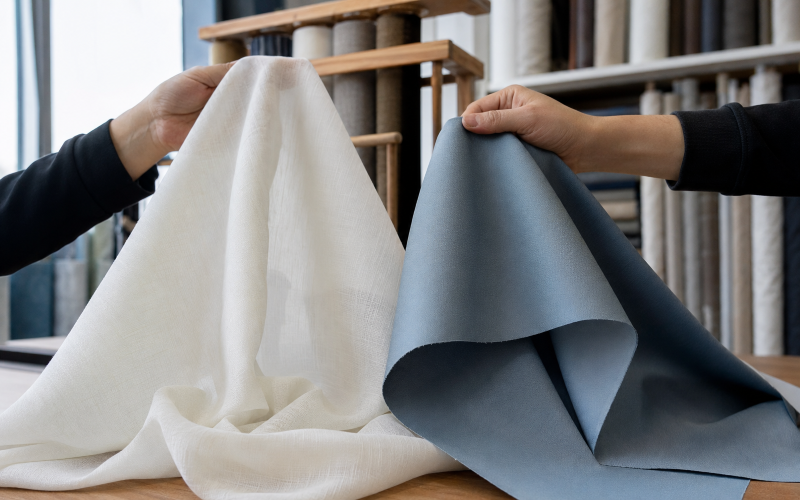
“Breathability” really means two different things. Let’s name them.
Air permeability — how much air passes through the fabric. Measured by ASTM D737 or ISO 9237, reported in CFM or mm/s. Higher = more air gets through; lower = the fabric is more “closed.” A back-coated blackout fabric will score much lower than an uncoated sheer of the same fiber, because the coating literally plugs the pores. The number itself is not pass/fail — it is a spec you set based on your space (a venting curtain needs more airflow than a static wall panel).
Moisture vapor transmission (MVTR) — how well water vapor escapes. Measured by ASTM E96 or ISO 15496. This matters for clothing and anything worn next to skin. For window drapery (not worn), air permeability is usually the one to focus on.
For peace of mind, always verify the flame retardant fabric you choose meets the necessary regulations.
The biggest breathability killer is the coating, not the FR chemistry. Blackout FR drapery needs a light-blocking layer, and that layer is what throttles air flow. If your space is stuffy or naturally ventilated, ask for the lightest coating that still meets your blackout requirement — or use an IFR base cloth with minimal coating.
One more thing: a curtain does not need to “breathe” like a shirt. For drapery, breathability is about avoiding a dead, stuffy air layer and getting good drape behavior. Do not borrow apparel standards for a curtain — match the threshold to the actual use.
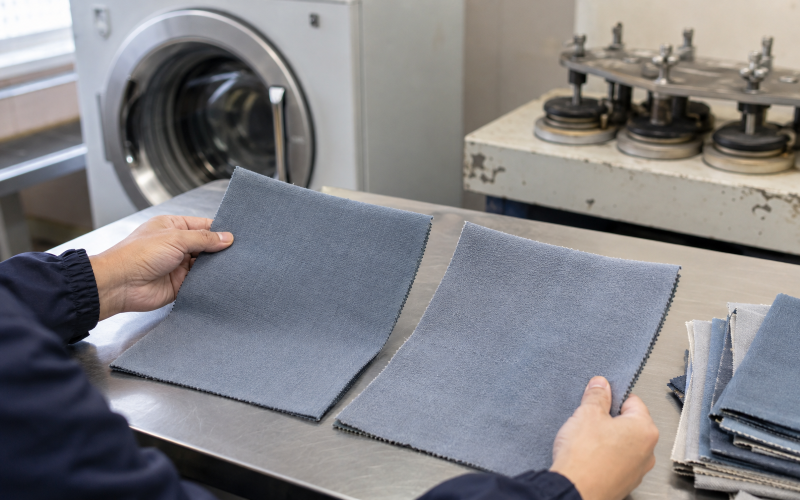
This is where FR method choices matter most over time.
Wash durability. Does the fabric (and its FR protection) survive laundering? AATCC 135 (US) and ISO 6330 (international) define standard wash procedures at set temperatures, detergents, and cycle counts. When a supplier says “washable to 50 washes,” that claim must be backed by a test report using one of these methods — ask for it. The key distinction:
Abrasion resistance. How well the fabric holds up to rubbing and contact. Two main tests: ASTM D4157 (Wyzenbeek, reported in “double rubs,” common in the US) and ISO 12947 (Martindale, reported in cycles, common in Europe). Heavy-duty contract upholstery might require tens of thousands of double rubs — but the right number comes from your project’s specification, not a generic rule of thumb. Note: a brittle coating can crack under abrasion, while an IFR base cloth wears like its non-FR version.
Lightfastness. Sunlight fades and weakens fabric over time. AATCC 16 and ISO 105-B02 measure this using xenon-arc exposure, rated on a scale of 1–8 (8 = best). South-facing windows, tropical locations, and marine glare are the toughest environments — specify a minimum grade and confirm it was tested properly if your project faces these conditions.
The bottom line on durability: A non-durable finish can wash out. A durable finish lasts to its rated count. IFR lasts the life of the fabric. The label “FR” does not tell you which one you are buying — always ask.
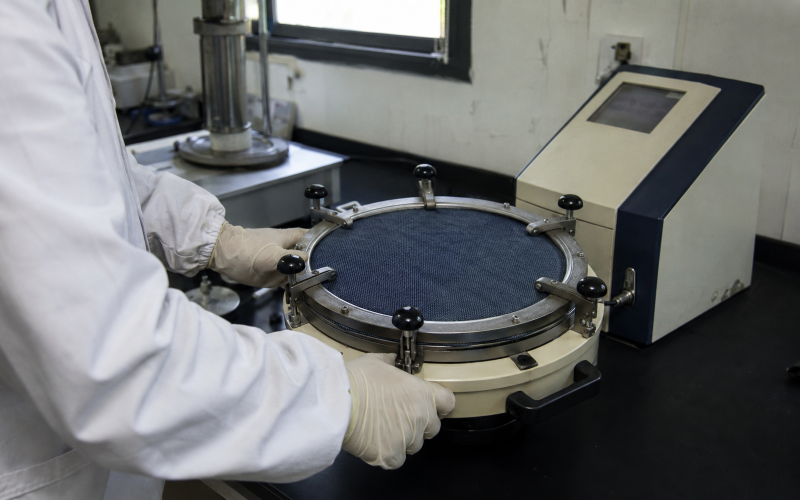
Instead of memorizing every test method, use this table to translate your project into the specs that matter.
| Application | FR method to look for | Comfort priority | Key durability check | Must-have tests on the report |
| Sheer curtain (lobby, home) | IFR or light finish | Soft, flowing drape | IFR = permanent; finish = rated washes | Air perm. (D737/ISO 9237); FR standard |
| Stage / theater drape | IFR preferred | Medium–full body | High abrasion if handled often | Abrasion (D4157/ISO 12947); NFPA 701 |
| Cruise / ship curtain | IFR or durable + coating | Soft but coated | Wash + abrasion rated; IMO Part 7 | IMO Part 7 result; air perm.; wash rating |
| Hospital curtain | Durable finish or IFR | Soft, washed frequently | High wash-cycle rating (AATCC 135) | AATCC 135 count; NFPA 701 |
| Contract upholstery | IFR or durable finish | Soft, rub-resistant | High abrasion (D4157) | Abrasion; NFPA 260 / CAL TB 117 |
| Transport interior | IFR preferred | Medium | Abrasion + sun exposure | EN 45545-2; ISO 12947; lightfastness |
Overall, the role of flame retardant fabric in safety and design cannot be overstated.
A “pass” at one level does not guarantee a pass at the next:
In conclusion, selecting the right flame retardant fabric is crucial for both safety and style.
Why this matters for comfort: A fabric swatch may test highly breathable, but a fully lined, back-coated finished curtain may not — the coating and lining only exist at the component or finished level. If your end use depends on how the final product actually feels and performs, specify your requirements at the finished-product level.
When choosing your flame retardant fabric, always consider its application.
“One FR treatment lasts forever.” Only IFR is permanent. Non-durable finishes can wash out; durable finishes are rated to a cycle count. Confirm which you are buying.r comes from your project’s specification, not a generic rule of thumb. Note: a brittle coating can crack under abrasion, while an IFR base cloth wears like its non-FR version.
“FR fabric isn’t breathable.” False as a blanket statement. It depends mostly on coating and construction. An IFR sheer can be very breathable. Ask for the air-permeability value.
“IFR is always softer.” Usually yes versus a treated equivalent, but not guaranteed — base fiber and any added coating still set the floor.
They can, but the effect is driven mostly by coatings and construction, not FR chemistry alone. IFR and lightly-finished cloth stay breathable; back-coated blackout FR fabric is less so. Request the ASTM D737 / ISO 9237 air-permeability value for your exact construction.
Many are. A sheer IFR curtain is typically quite breathable; a blackout FR curtain is less so because of its light-blocking coating. Match the breathability requirement to the application rather than assuming a yes/no answer.
It depends on the type. A non-durable FR finish can lose performance after a few washes; a durable FR finish is rated to a stated cycle count under AATCC 135 / ISO 6330; IFR does not wash out because the resistance is in the fiber. Always ask which type the label means.
Generally yes compared with a chemically treated equivalent, because there is no stiffening finish. But the base fiber and any coating still govern the final hand feel — softness is not automatic.
A treated FR fabric may feel slightly crisper; an IFR fabric of similar construction feels close to its non-FR counterpart. For drapery the difference is often minor; for close-contact or apparel uses, specify IFR or request a hand-feel sample.
The best materials for flame retardant applications include fiberglass, aramid fibers (such as Kevlar), melamine foam, and certain treated textiles. Additionally, materials like Nomex and certain types of polyester can also be effective.
Flame-retardant fabric protection is not a single switch that ruins comfort. It is a set of engineering choices: which FR method, how much coating, what base fiber, and what tests you specify. Treat “FR” as the start of a specification, not the end of one — name the comfort, breathability, and durability tests you need, at the right testing level, for your market. The result is a fabric that is both compliant and pleasant to live or work with.
Browse compliant FR sheer, blackout, dimout, and cruise fabrics, or contact BEGOODTEX with your project details to find the right balance.