Enter your details and we will send the requested document to your inbox.



There is a very common misunderstanding in the flame-retardant textile industry: if a fabric is called flame-retardant, it should not burn.
For example, a customer buys flame-retardant curtains and wants to test their flame-retardant performance. The customer takes a lighter and holds the flame near the fabric.
But what happens next may be very different from what the customer expects.
Where the fabric touches the flame, it starts to turn black and shrink. There may even be a brief flame and some smoke. After the heat source is removed, the flame may go out quickly. But the fabric already has clear burn marks, or even a hole.
This naturally raises a few questions:
Why does flame-retardant fabric still get burned? Can a fabric that burns really be called flame-retardant?
Can what we call “fireproof fabric” really avoid burning completely?
In fact, these questions all come from the same misunderstanding. We treat “stopping flames from spreading” and “a material that cannot burn” as the same thing.
The fact is, flame-retardant does not mean a fabric cannot burn. It also does not mean the fabric will not be damaged when it touches a flame.
The main purpose of flame-retardant fabric is to make it less likely to catch fire, limit continued burning, and slow flame spread. It is not to keep the fabric completely undamaged in a flame.
To understand this, we first need to answer one question: How exactly does flame-retardant fabric work?
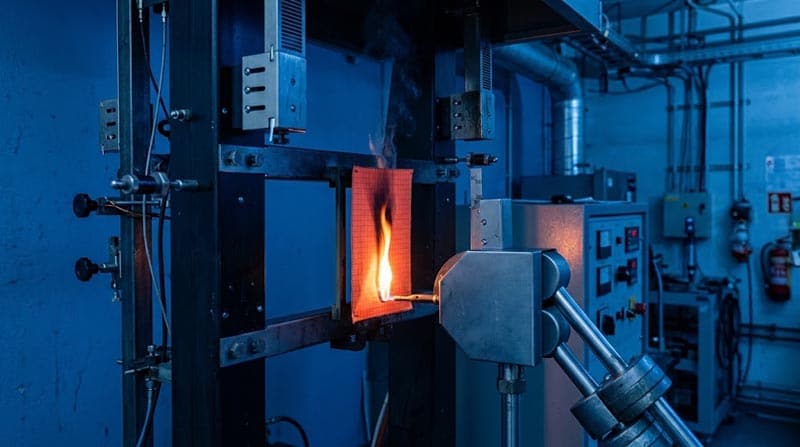
Flame-retardant fabric is not fabric that can never burn. It uses special fiber structures or flame-retardant technology to change how the material burns. This helps slow down or reduce burning.
To understand flame retardancy, we first need to know how ordinary fabrics burn.
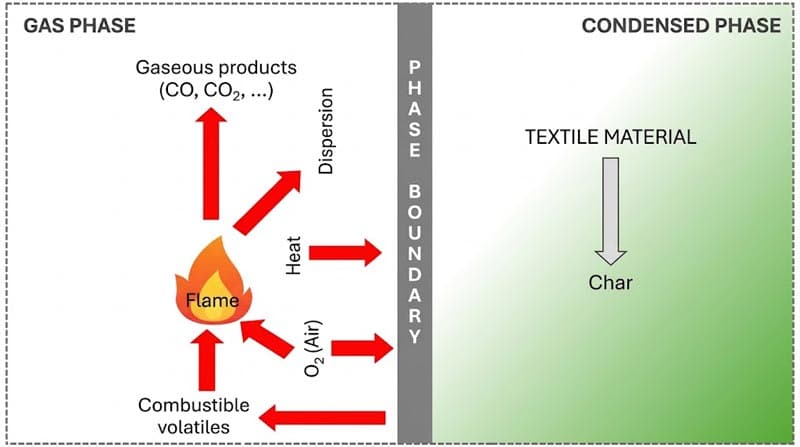
When a fabric is exposed to enough heat, some fibers break down and release flammable gases. These gases react with oxygen in the air and produce flames.
Heat from the fire then heats nearby material that has not yet burned. This keeps the burning process going and allows the flames to spread.
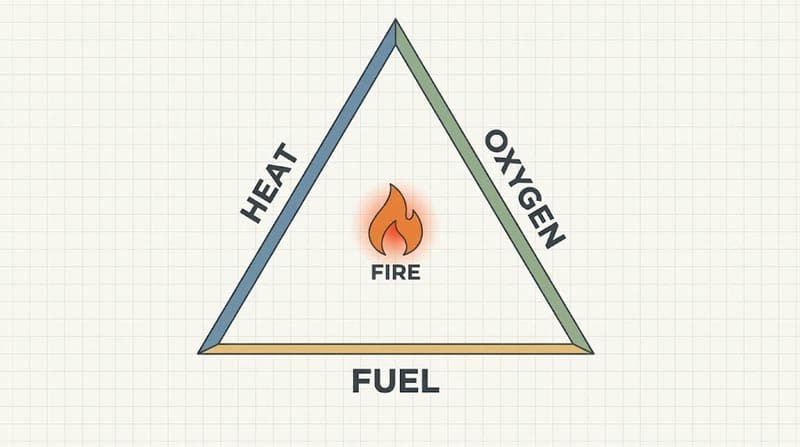
So continued burning needs fuel, oxygen, and enough heat.
Flame-retardant technology works by interrupting or weakening parts of this process. This makes it harder for flames to continue or spread.
According to research by the US National Institute of Standards and Technology (NIST), flame retardants can work in the solid material (the condensed phase) or in the gas phase. In real materials, several mechanisms may work together.
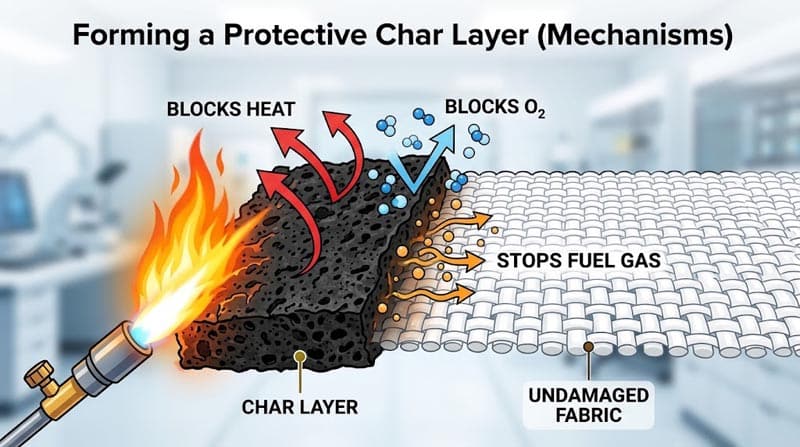
Some flame-retardant systems help a material form a relatively stable char layer when heated.
This layer can partly block the movement of heat, oxygen, and flammable gases released as the material breaks down. This helps slow further breakdown and burning.
That is why some flame-retardant fabrics turn black and form char when they touch a flame.
For example, cotton with a suitable flame-retardant treatment may form a char layer as it burns. This helps slow flame spread.
However, not all flame-retardant fibers rely mainly on char formation.
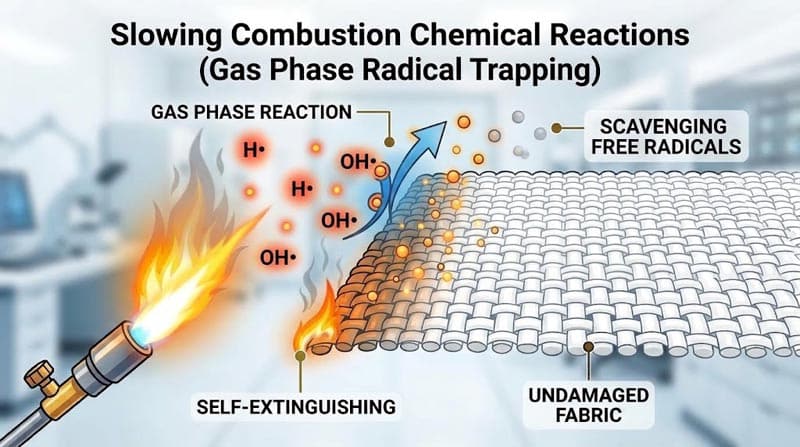
Flames keep burning because of a series of chemical reactions in the gas phase.
Some flame-retardant systems can interfere with these reactions. They reduce burning and heat release, making it harder for flames to continue.
As a result, some flame-retardant fabrics may show a brief flame but stop burning after the outside flame source is removed.
However, whether a fabric can self-extinguish, and how long it takes, still depends on the material and test conditions.
Some flame-retardant systems change how fibers break down when heated. This reduces the amount of flammable gases they release.
Other systems absorb heat or form a protective barrier. This reduces the heat that returns to the material’s surface.
These effects slow further heat breakdown and make it harder for flames to keep spreading to nearby fabric.
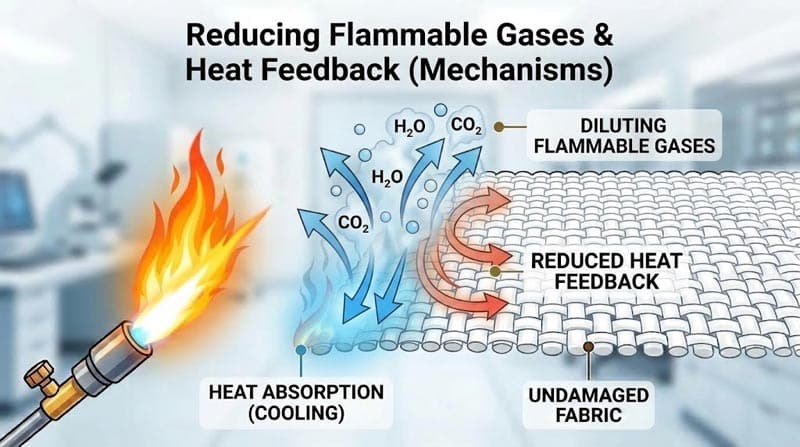
Different flame-retardant materials work in different ways, but they share one goal:
Flame retardancy does not stop flames from touching or damaging a fabric. It changes how the fabric burns and reduces the risk of continued burning and flame spread.
This partly explains what happened at the beginning of the article. Even if flame-retardant fabric changes when exposed to a flame, it does not necessarily mean its flame-retardant performance has failed.
But why do some fabrics not only turn black, but also shrink or even develop a hole?
This has to do with the physical and chemical properties of the fibers themselves.
Because flame-retardant performance and the physical changes caused by heat are two different things.
Flame-retardant technology can change how a fabric burns. But it may not stop melting, shrinking, charring, or other damage caused by high temperatures.
Different fibers also react differently when they touch a flame.
Polyester is a thermoplastic fiber. Even when it has been modified to be flame-retardant, it still has its basic thermoplastic properties.
When the temperature in one area becomes high enough, flame-retardant polyester may soften, melt, or shrink. This can leave a hole in the fabric.
For example, when a lighter flame touches an inherently flame-retardant polyester fabric, the flame may go out quickly. But the heated area may already have shrunk or formed a hole.
This is because the material may already have been damaged by heat, while its flame-retardant mechanism may still help limit continued burning.
So a hole does not necessarily mean the fabric has no flame-retardant properties.
Unlike polyester, cotton is a cellulose fiber. It does not usually melt like thermoplastic polyester.
After suitable flame-retardant treatment, cotton may form a char layer when heated. This can help slow burning.
So when flame-retardant cotton touches a flame, it may develop black charred areas, local damage, or even holes as the fiber structure breaks down.
Likewise, the fact that a fabric chars does not mean it cannot burn at all.
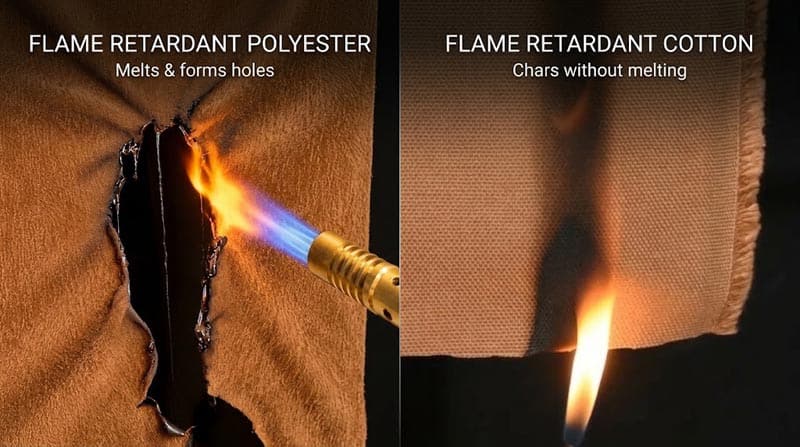
These two examples show that:
The key point is that heat damage to a fabric is not the same as whether flames can keep burning and spread to nearby areas.
So we cannot judge whether a fabric meets flame-retardant requirements just by checking whether it has been burned or has a hole.
Then, if flame-retardant fabrics can still be damaged by fire, can what we call “fireproof fabrics” really avoid burning completely?
Not necessarily. Fireproof fabric does not mean a fabric can never burn under any conditions. It also does not mean it can never be damaged.
In the textile industry, “fireproof fabric” is a broad term. Some materials have flame-retardant properties, while others are non-combustible. These are not exactly the same.
Flame retardancy mainly means a material can resist ignition, continued burning, and flame spread.
Non-combustibility means a material does not burn, or takes little part in burning, under specified test conditions.
For example, flame-retardant polyester can still melt or break down in a flame. Fiberglass, on the other hand, is an inorganic fiber and is generally non-combustible.
So a fabric can have flame-retardant properties without being a non-combustible material.
No, it does not.
For example, fiberglass is generally non-combustible. But at high enough temperatures, it may still soften or lose mechanical strength.
This shows that a material not burning and a material not being damaged by fire are two different things.
So neither flame-retardant fabric nor fireproof fabric should simply be understood as something that can never burn or be damaged.
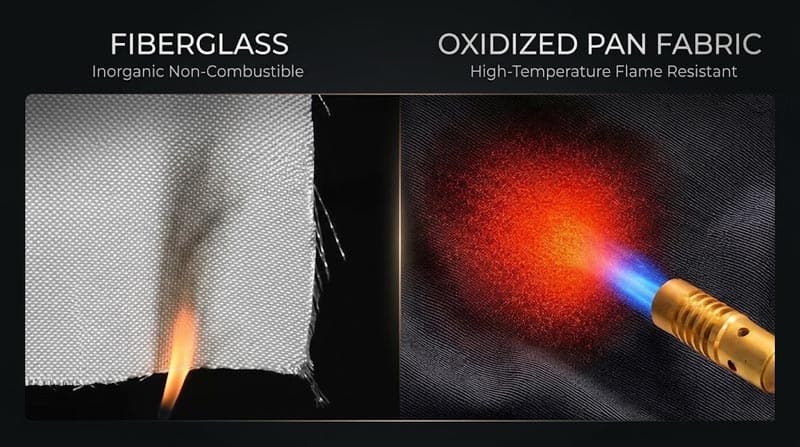
Flame retardancy and fireproofing are not exactly the same. More importantly, we cannot simply assume that flame-retardant fabric is fabric that cannot burn.
Flame retardancy focuses on resisting ignition, reducing continued burning, and limiting flame spread. Fireproofing is a broader concept. It may involve non-combustibility, resistance to flames, and other protective properties.
Both relate to fire, but they do not always describe the same performance.
| Feature | Flame Retardancy | Fireproofing |
|---|---|---|
| Core meaning | Slow or reduce burning and limit flame spread. | Resist flames or provide protection against fire. The actual performance depends on the material. |
| Can it catch fire? | It may still catch fire under certain conditions. | It is not necessarily impossible to ignite. This depends on whether the material is non-combustible. |
| Reaction to direct flame | It may burn briefly, melt, shrink, or char. | It may not burn, but it may also char, change shape, or be damaged. |
| After the flame source is removed | It may self-extinguish or burn for only a limited time, depending on performance and test conditions. | It does not always self-extinguish immediately. This depends on the material’s burning behavior. |
| Flame spread | One main goal is to slow or limit flame spread. | It may limit flame spread, but the name “fireproof” alone does not tell us the actual performance. |
| Does it mean non-combustible? | No. | Not necessarily. Only materials that meet the relevant non-combustibility requirements can be called non-combustible. |
As the table shows, flame retardancy describes how a material resists or limits burning. Non-combustibility describes the material’s burning properties under specified conditions.
Even a fabric with good flame-retardant performance may burn briefly, shrink, or char when exposed to a flame. Yet under specified conditions, it may still limit continued burning and flame spread.
So we cannot directly judge whether a fabric meets flame-retardant requirements by whether it has burn marks or holes.
Likewise, “fireproof fabric” does not mean a fabric can never burn. We need to know its actual burning performance and test results before deciding whether it is non-combustible.
Now, let’s return to the question we raised at the beginning.
The answer is no.
The main purpose of flame retardancy is to reduce the risk of ignition, continued burning, and flame spread. It does not make a material completely non-combustible.
So even a fabric that meets flame-retardant standards may burn or be damaged when it comes into direct contact with a flame.
Not necessarily.
When flame-retardant fabric touches a flame, it may still melt, shrink, char, or suffer local damage.
These are possible changes caused by heat. They cannot, on their own, tell us whether the fabric meets flame-retardant requirements.
To judge flame-retardant performance, we need to use the relevant standards and assess how the fabric burns under specified test conditions.
So flame-retardant does not mean non-combustible, and fireproof does not necessarily mean non-combustible either. The key is not whether a fabric can be damaged by fire. It is whether the fabric can effectively limit burning and flame spread under specified conditions.
That is why we cannot simply say a flame-retardant fabric has no flame-retardant properties just because a lighter leaves burn marks or even a hole.
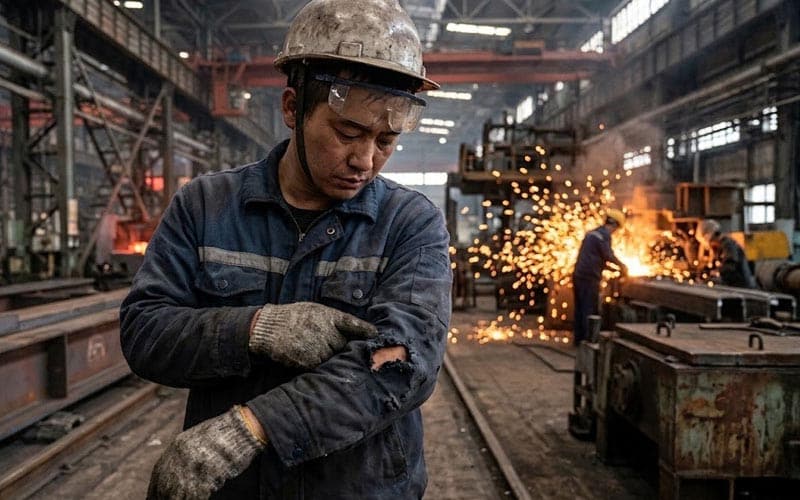
A lighter test alone cannot tell us whether a fabric meets flame-retardant requirements.
A lighter can show some of the ways a fabric reacts to fire, such as shrinking, melting, charring, or burning briefly.
But this kind of test cannot accurately control the flame size, exposure time, sample size, burning direction, or other factors that affect the result.
Formal flame-retardant tests follow specific standards. They control the test method and assess the relevant burning performance.
For example:
Different flame-retardant standards use different test items and pass criteria. Not every standard measures all of these factors.
So when buying flame-retardant fabric, a more reliable approach is to check whether the product meets the relevant standard and review its test report.
We also do not recommend that consumers use open flames to test large textiles such as curtains at home.
Different materials have different fiber structures and burning properties. This makes them suitable for different uses.
Its flame-retardant properties come from the fibers themselves, giving it lasting flame-retardant performance.
It is easy to make into different fabrics, including blackout, jacquard, linen-look, and velvet fabrics. It is commonly used for hotel curtains, stage curtains, and hospital privacy curtains.
Cotton fibers are naturally combustible. They are usually treated to achieve the required flame-retardant performance.
Flame-retardant cotton can keep much of its softness and ability to absorb moisture. Depending on its performance, it can be used for workwear, bedding, and other textile products.
These fabrics combine different fibers to balance flame retardancy, strength, comfort, and other needs.
The actual flame-retardant performance still needs to be checked by testing the finished fabric.
 Flame Retardant Black Cotton Stage Curtain Fabric with No Molten Dripping for Theater Projects | 160/300 g/m² | 300 cm | NFPA 701
 Inherent Flame Retardant Polyester Satin Dimout Curtain Fabric for Hospitality Interiors | 230 g/m² | 220/280 cm | NFPA 701
 Inherent Flame Retardant High-Count Cotton-Nylon Blended Plain Weave Shirting Fabric for Workwear | 150 g/m² | 148 cm | EN ISO 11612
Aramid has good flame retardancy, heat stability, and mechanical properties. It is widely used in firefighter clothing, industrial protective clothing, and special industrial applications.
It has high flame resistance and usually does not melt and drip like ordinary thermoplastic fibers. It can be used in some industrial protective and insulation products.
These are inorganic fiber materials. They are generally non-combustible and have good heat stability. They can be used in industrial protective blankets, fire barriers, and other special protective products.
 Flame Resistant Aramid Modacrylic Protective Clothing Fabric from a China Textile Mill | 210 g/m² | 150 cm | EN ISO 11612
 Fireproof Oil-Free Oxidized PAN Fabric for Welding and Thermal Protection with Wholesale Supply Options | 300 g/m² | 150 cm | EN ISO 11612
 Fireproof White Fiberglass Fabric with Heat Resistance for Industrial Equipment Covers | 255 g/m² | 100 cm | EN 13501-1 A2-s1, d0
When choosing flame-retardant or fireproof fabric, what matters is not the name. It is the actual application and the performance required.
For example:
| Application | Main risk to consider | Fabric selection |
|---|---|---|
| Hotel curtains | Flames spreading along hanging fabric | Curtain fabrics such as IFR polyester that meet the relevant flame-retardant requirements |
| Hospital privacy curtains | Flame spread, cleaning, and hygiene needs | Medical curtain fabrics with suitable flame-retardant performance |
| Stage curtains | Flame spread across large hanging fabrics | Flame-retardant curtain fabrics that meet project requirements |
| Industrial welding protection | Sparks, molten metal splashes, and similar hazards | Special protective materials that have passed the relevant tests |
BEGOODTEX focuses on the research, development, production, and supply of flame-retardant and special functional textiles. We provide suitable textile materials for different environments.
We offer inherently flame-retardant polyester, flame-retardant cotton, and other functional fabrics. They can be used for hotel curtains, stage curtains, hospital privacy curtains, and decorative fabrics in public buildings.
Depending on project needs, we can provide different fabric structures, weights, widths, colors, and relevant test information.

In addition to standard flame-retardant fabrics, BEGOODTEX also offers high-performance textile materials such as aramid, carbon fiber, and fiberglass.
We help customers choose suitable fabrics based on the actual environment, target market, and specific performance needs. We also provide relevant technical information and test reports.
Not necessarily.
Some flame-retardant fabrics can self-extinguish under specified conditions or continue flaming for only a limited time.
But actual performance depends on the fiber type, flame-retardant system, and flame conditions. Even if a fabric passes a flame-retardant test, it is not guaranteed to go out immediately in every real fire.
Because polyester is a thermoplastic fiber. Even with flame-retardant properties, it can still melt or shrink at high enough temperatures.
So a hole does not, by itself, tell us whether the fabric has flame-retardant properties.
No.
Permanent flame retardancy usually means the flame-retardant properties come from the fibers themselves and have good durability.
But long-term wear, extreme conditions, or other factors that affect the material can still change its performance.
Fiberglass is an inorganic material that is generally non-combustible. It is also widely used in fireproof and industrial protective textiles.
But non-combustible does not mean it cannot be damaged by heat. At high enough temperatures, fiberglass can still soften or lose mechanical strength.
Check the flame-retardant standards that apply to your target market and project, and review the relevant test reports.
For example, projects in the US may use NFPA 701, projects in the UK may use BS 5867-2, and some European projects may use EN 13773 to classify burning behavior.
The exact requirements still depend on local rules and project specifications.