Enter your details and we will send the requested document to your inbox.



In a recent project involving functional and flame retardant textiles, BEGOODTEX submitted its flame retardant acoustic fabric for third-party testing. The sample passed the surface flammability test carried out by SGS under IMO 2010 FTP Code Annex 1, Part 5. The test report number is AJFTS26008480R01_EN.
Key test findings: The test results show that the wall system can self-extinguish under heat radiation. The average Critical Flux at Extinguishment (CFE) reached 27.4 kW/m2. Total Heat Release (Qt) was only 0.06 MJ, and the Peak Heat Release Rate (Qp) was just 0.1 kW. No burning droplets were produced during the test. The tested system meets the low flame spread requirements for ship bulkhead, wall, and ceiling lining materials.

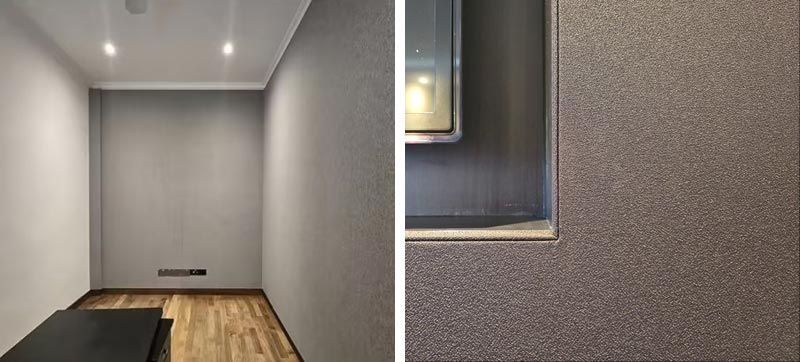
Flame retardant acoustic fabric is used in indoor spaces such as ship cabins, theaters and auditoriums, meeting rooms, and hotels. It helps absorb sound reflections and improve acoustic comfort. At the same time, it needs reliable flame retardant performance to help limit fire spread along wall surfaces.
In ship interiors and other enclosed spaces with strict fire safety rules, passageways can be narrow. Evacuation may also be difficult. If large wall coverings catch fire, flames can spread quickly along the wall and release more heat.
The test was carried out by SGS, an international third-party testing and inspection organization. It followed IMO 2010 FTP Code Annex 1, Part 5, issued by the International Maritime Organization (IMO). The test measures surface flame spread and heat release when a material is exposed to heat radiation that simulates fire conditions.
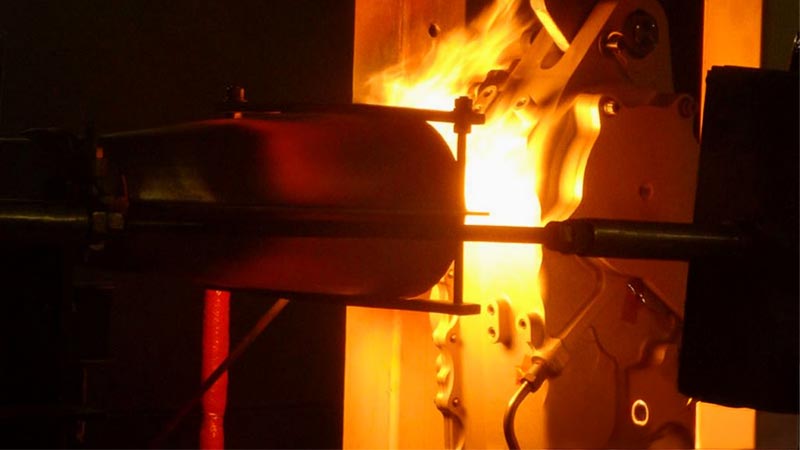
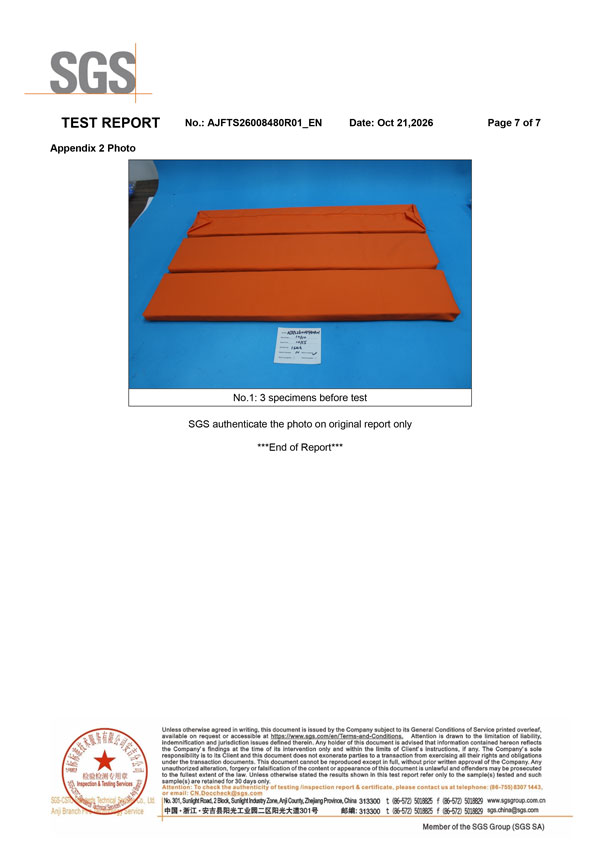
According to SGS report AJFTS26008480R01_EN, the samples were received and tested in October 2026. The laboratory followed IMO 2010 FTP Code Annex 1, Part 5. The aim was to reflect how the acoustic fabric would be installed on a ship bulkhead or building wall. The process included four steps:
What does this test mean in simple terms? It is more than holding a small flame against the edge of a fabric. The complete acoustic wall system is exposed to strong heat radiation and an ignition flame. The test shows how far the flame spreads, how much heat is released, and whether the fire goes out on its own.
All three specimens passed the five main indicators in the SGS surface flammability test. These were Critical Flux at Extinguishment (CFE), Heat for Sustained Burning (Qsb), Total Heat Release (Qt), Peak Heat Release Rate (Qp), and Burning Droplets. The reported average results also showed a clear margin against the limits in the standard.
The following table brings together the laboratory results from pages 4 and 5 of the SGS report. It helps engineers and buyers compare the measured values with the IMO Part 5 requirements.
| Test Item | Specimen 1 | Specimen 2 | Specimen 3 | Average of 3 Tests | IMO Part 5 Requirement | Result |
|---|---|---|---|---|---|---|
| Critical Flux at Extinguishment, CFE (kW/m2) | 27.8 | 26.5 | 27.8 | 27.4 kW/m2 | ≥ 20.0 kW/m2 | Pass |
| Heat for Sustained Burning, Qsb (MJ/m2) | 1.53 | 1.55 | 1.68 | 1.6 MJ/m2 | ≥ 1.5 MJ/m2 | Pass |
| Total Heat Release, Qt (MJ) | 0.062 | 0.052 | 0.065 | 0.06 MJ | ≤ 0.7 MJ | Pass |
| Peak Heat Release Rate, Qp (kW) | 0.140 | 0.140 | 0.150 | 0.1 kW | ≤ 4.0 kW | Pass |
| Burning Droplets | 0 | 0 | 0 | None (0) | Not produced | Pass |
| Test Duration (min:s) | 10:00 | 10:00 | 10:00 | 10:00 | Full 10:00 exposure | Completed |
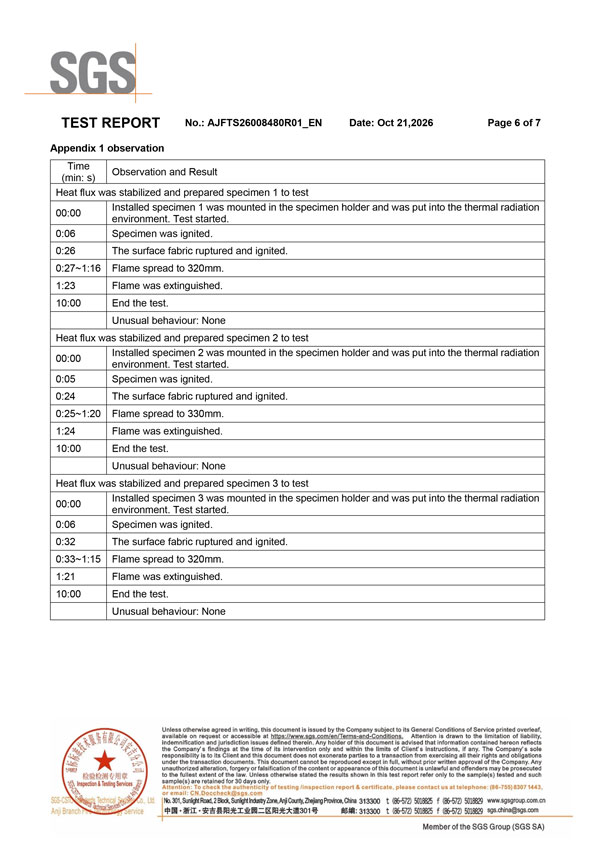
Appendix 1 (Observation) of the SGS report records how each specimen reacted during the 10-minute test. These observations go beyond the summary numbers. They show when the material ignited, how far the flames spread, and when the flames went out.
| Specimen | Test Start | Initial Ignition | Surface Fabric Breaks and Ignites | Flame Spread Period and Maximum Distance | Complete Self-Extinguishment | Test End | Unusual Behaviour |
|---|---|---|---|---|---|---|---|
| Specimen 1 | 00:00 | 0:06 | 0:26 | 0:27–1:16 (up to 320 mm) | 1:23 | 10:00 | None |
| Specimen 2 | 00:00 | 0:05 | 0:24 | 0:25–1:20 (up to 330 mm) | 1:24 | 10:00 | None |
| Specimen 3 | 00:00 | 0:06 | 0:32 | 0:33–1:15 (up to 320 mm) | 1:21 | 10:00 | None |
The three specimens first ignited after 5 to 6 seconds of heat exposure. Their surface fabrics broke and ignited between 24 and 32 seconds. However, the flames did not keep spreading downward.
The flames went out completely at 1 minute 23 seconds, 1 minute 24 seconds, and 1 minute 21 seconds. The specimens remained under heat radiation for more than another 8 minutes and 30 seconds. No re-ignition was observed.
Each specimen was 800 mm long. The flames reached only 320 mm to 330 mm before stopping. The average Critical Flux at Extinguishment (CFE) was 27.4 kW/m2.
A higher CFE means that stronger external heat radiation is needed to keep the material burning. When the flame moves away from the hottest area, it can go out because there is not enough heat to sustain burning.
The average Total Heat Release (Qt) was just 0.06 MJ. This is less than one-tenth of the standard limit of 0.7 MJ. The reported Peak Heat Release Rate (Qp) was 0.1 kW, equal to 2.5% of the 4.0 kW limit.
None of the three specimens produced burning droplets, burst apart, or came loose from the specimen holder. The report recorded “Unusual behaviour: None”.

Section 7 (Classification) of the SGS report confirms that the tested flame retardant acoustic fabric meets the “Low flame spread” requirements of IMO 2010 FTP Code Annex 1, Part 5 for bulkhead, wall, and ceiling linings. The very low heat release results also meet the conditions for being treated as compliant with IMO Part 2 without an additional smoke and toxicity test.
When reviewing maritime fire test reports, marine engineers and buyers often check how Part 5 (Surface Flammability Test) relates to Part 2 (Smoke and Toxicity Test) under the IMO 2010 FTP Code.
In general, interior surface materials must meet Part 5. They may also need Part 2 testing to show that they do not produce excessive smoke or toxic gases when burning.
However, Section 7.2 of this SGS report states an important exemption condition.
Under IMO 2010 FTP Code Annex 1, Part 5, Appendix 4, Clause 2.7, the sample can qualify if its Total Heat Release (Qt) is no more than 0.2 MJ and its Peak Heat Release Rate (Qp) is no more than 1.0 kW. In that case, the sample can be considered to meet Part 2 requirements without a separate Part 2 test.
For this sample, Qt was 0.06 MJ, below the 0.2 MJ threshold. Qp was 0.1 kW, below the 1.0 kW threshold.
This finding offers three practical benefits for projects and purchasing teams:
It is important to keep the following limits in mind when using the results for material selection:
For B2B flame retardant textile and acoustic wall covering projects, buyers should first match the material system to the required fire safety standards. These may include IMO FTP Code, EN 13501-1, or NFPA 701. The final installation structure also matters. Third-party laboratory test results should be used to verify compliance.
At BEGOODTEX, our work on functional textiles starts with real project requirements. We use material testing and product development to support different applications.
The flame retardant acoustic fabric submitted for a BEGOODTEX project passed the SGS surface flammability test under IMO 2010 FTP Code Annex 1, Part 5. Here are the main findings:
It means the tested material meets the “Low flame spread” requirements under heat radiation and flame exposure. The sample released very little heat and produced no burning droplets. It met the IMO fire safety requirements for ship bulkhead, wall, and ceiling lining materials.
Under IMO 2010 FTP Code Annex 1, Part 5, Appendix 4, Clause 2.7, a sample can be considered to meet Part 2 (smoke and toxicity) requirements if it meets two limits in the Part 5 test. Total Heat Release (Qt) must be no more than 0.2 MJ. Peak Heat Release Rate (Qp) must be no more than 1.0 kW. The tested sample recorded a Qt of just 0.06 MJ and a Qp of just 0.1 kW. Both values were well below the exemption limits. No separate Part 2 test was required under this provision.
For projects with strict fire safety requirements, such as ship interiors and theaters, it is better to test the complete wall system. Heat can pass through the surface fabric and affect the acoustic layer and backing board. A flame retardant surface fabric is important, but a full assembly test shows how all the layers work together under heat exposure.
Yes. BEGOODTEX is a flame retardant fabric manufacturer. We can customize fabric composition, weight, width, and color to match project requirements. We can also develop additional functions, including sound transmission, blackout, waterproof, and antibacterial properties. Third-party flame retardant testing support and B2B bulk supply are also available based on the project needs.