Get in touch
Thank you for reaching out! Please tell us more about your needs — our expert team will get back to you within 24 hours.




Every year, arc flashes, flash fires, molten metal, and welding sparks injure thousands of workers who simply were not wearing the right gear. Flame retardant clothing is the difference between a near miss and a life-changing burn. But “FR clothing” is not one product — it is a system of fabric chemistry, garment design, certified performance levels, and care routines that must work together. This guide walks safety managers and procurement buyers through how to choose FR workwear that actually protects, complies with the standards your industry is audited against, and stays effective for years.
Quick answer: Flame retardant clothing is engineered from fibers or treatments that resist ignition and stop flames from spreading. The right choice depends on your hazard profile (heat, arc, molten metal, chemicals), the applicable standard (ISO 11612, EN 469, NFPA 2112), and the comfort your crew will actually wear.
The fabric is the heart of any flame retardant clothing system. When a worker is exposed to flame or extreme heat, the material must not ignite, melt, or drip onto the skin. FR workwear is built from two broad families.
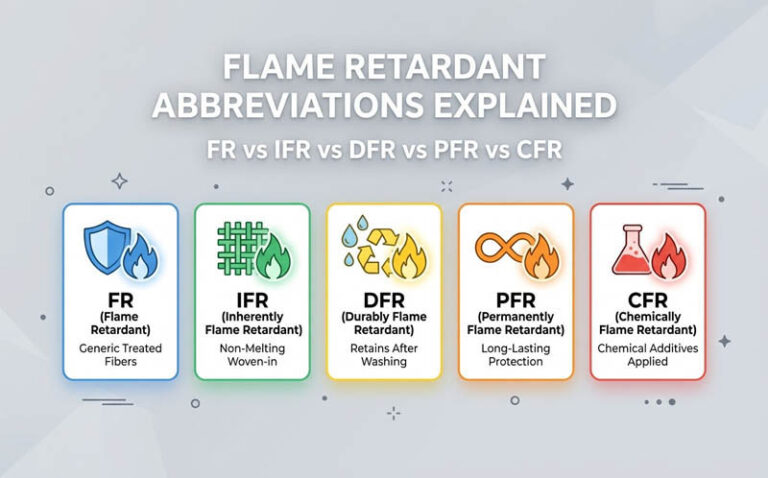
Inherently flame-resistant (IFR) fibers carry protection inside the polymer itself. Aramids (such as meta-aramid blends), modacrylics, and oxidized PAN (OPF) fibers do not melt or drip when exposed to high temperatures — they char and self-extinguish. BEGOODTEX builds FR workwear fabrics on these fiber platforms, and you can explore the aramid FR category and IFR modacrylic category for fiber-specific options.
Treated (or “FR-treated”) cotton is the other common route. Here, chemical finishes give ordinary cotton its fire resistance. The result is comfortable and cost-effective, which is why the FR cotton category remains popular for general industrial wear. The trade-off is that protection lives in the finish, so it degrades with washing and abrasion — more on care below.
A practical middle ground is the inherent FR polyester base fabric, which pairs permanent protection with the easy-care behavior buyers expect from polyester.

Real workplaces rarely face a single hazard. Good flame retardant clothing layers additional protections on top of fire resistance.
In environments with flammable gases or dust — petrochemical plants, grain handling, powder coating — static discharge can ignite the atmosphere. Anti-static FR garments weave conductive fibers or grids into the fabric to dissipate charge before a spark forms.
For workers exposed to rain, splashes, or aggressive chemicals, water- and chemical-resistant FR textiles combine a repellent outer layer with the base FR protection, so liquids never soak through to the skin. This dual-function approach is increasingly the default for offshore, utility, and chemical-industry crews who need flame retardant clothing that does both jobs at once.
Fabric alone does not make flame retardant clothing safe. How the garment is cut and finished determines whether protection reaches the worker in motion.
A close-fit design minimizes loose ends that could catch fire, snag on machinery, or drag through a hazard. For operators in high-risk areas where precision and mobility matter, a trim, articulated cut is safer than a baggy one.
Visibility is the second design pillar. Reflective markings placed on the torso and limbs keep workers visible to peers and vehicles in low-light conditions. BEGOODTEX offers a fluorescent two-tone FR reflective fabric built exactly for this — high-visibility trim that still meets flame-resistance requirements.

The level of protection any flame retardant clothing provides must match the specific hazard. Three standards dominate global FR workwear specifications:
The table below maps common applications to the standard buyers should specify:
| Industry / Application | Applicable Standard | Key Scope |
| General high-temperature (metallurgy, foundries, welding support) | EN ISO 11612:2015 | Heat & flame, molten metal splash |
| Structural firefighting | EN 469:2020 | Full firefighting suit, radiant heat, steam |
| Oil & gas, petrochemical flash fire | NFPA 2112:2018 | Industrial flash-fire FR clothing |
| Electrical utilities | EN ISO 11612 + NFPA 2112 | Heat/flame + arc-flash hazard |
| Emergency rescue | EN 469:2020 | High-temperature rescue operations |
BEGOODTEX supplies fabrics certified to these benchmarks, including the NFPA 2112 heavy-duty oxidized-PAN workwear fabric and an ISO 11612 fireproof apron fabric for task-specific protection. Always confirm the exact certification on the test-report page before specifying.
A garment that is technically compliant but unbearable will be unzipped, modified, or left in the locker. Even the best flame retardant clothing fails if nobody will wear it, so comfort is a safety feature, not a luxury.
Breathable FR fabrics allow air circulation and wick moisture away from the skin, preventing heat stress during long shifts. Flexibility comes from stretchable fibers and ergonomic patterning that move with the body. Adjustable closures and elasticized panels fine-tune the fit across body types. When comfort and protection are both designed in from the start, compliance stops being a battle.
Flame retardant clothing is a long-term safety investment, so it has to survive the job and the wash cycle.
Stain-resistant finishes create a barrier that keeps grease and grime on the surface, reducing wash frequency and preserving the protective coating. Washability is the critical test: quality FR garments hold their performance through many industrial launderings. Avoid harsh detergents and bleach, which attack protective finishes. Abrasion resistance matters most in construction, mining, and heavy machinery — fabrics engineered against fraying and tearing keep the protective barrier intact where it is needed most. For care specifics, see our guide on how to wash FR clothes without losing protection.
BEGOODTEX flame retardant clothing is engineered from advanced fibers that meet stringent safety standards and do not melt or drip under heat. The range covers moderate-heat needs (ISO 11612) through extreme conditions (EN 469 / NFPA 2112), without trading away comfort.
Beyond fire resistance, the line adds antibacterial treatment that inhibits bacterial and fungal growth — valuable where crews sweat for hours — and water resistance that repels rain and chemical splashes. Combining these functions in one garment means fewer separate layers and fewer failure points on the job.
 OEKO-TEX Certified Flame Retardant Clothing 100% Pure Cotton T-Shirt for Industrial Workwear Bulk Order
 NFPA 2112 Certified Aramid IIIA Fireproof Henley Shirt Flame Retardant Garments Factory Direct Price
 NFPA 2112 Certified Aramid 3A Fireproof Jacket for Forest Firefighting OEM/ODM Factory Direct
It depends on the hazard. When buying flame retardant clothing, specify ISO 11612 for general heat and flame, EN 469 for structural firefighting, and NFPA 2112 for industrial flash-fire risk (oil & gas, chemical). Electrical utilities often require dual compliance with both ISO 11612 and NFPA 2112 for arc-flash protection.
Properly certified FR garments are safe for prolonged skin contact. Concerns about toxicity usually refer to certain legacy chemical treatments; modern certified FR clothing is regulated and tested for human safety. Our deeper look at whether FR protective clothes are toxic covers the nuance.
Inherent FR keeps protection for the life of the garment and survives repeated washing; treated FR is initially cheaper and comfortable but loses protection as the finish wears. The inherent vs. treated FR guide breaks down the cost and performance trade-offs.
Use mild detergent, skip bleach and fabric softeners, and follow the manufacturer’s industrial-laundering guidance. Treated-FR garments lose protection faster, so track wash counts. See the FR clothing washing guide for the full routine.
Start with a hazard assessment: what heat, arc, molten-metal, or chemical exposure exists? Match that to the standard above, then confirm the fabric certification on the supplier’s test report. When in doubt, specify to the stricter applicable standard.
Specifying flame retardant clothing is a system decision: the right fiber, the right multifunction layer, a safe garment design, a certified protection level, and a care routine that preserves it. Treat every garment as part of one protective system, not a standalone item. Anchor your selection to the hazard and the standard your industry is audited against — ISO 11612, EN 469, or NFPA 2112 — and verify certification before you buy.