Enter your details and we will send the requested document to your inbox.





For many buyers, fire resistant (FR) fabrics are still associated with stiffness, rough texture, and a plastic-like feel. This perception often becomes a barrier when FR fabrics are required for applications where comfort, aesthetics, and user experience matter just as much as fire safety.
At BEGOODTEX, we believe that fire resistance should never come at the cost of comfort. Through advanced fiber selection, fabric engineering, and finishing technologies, BEGOODTEX develops FR fabrics that combine certified flame-retardant performance with soft, textile-like hand-feel, suitable for both industrial and people-facing environments.
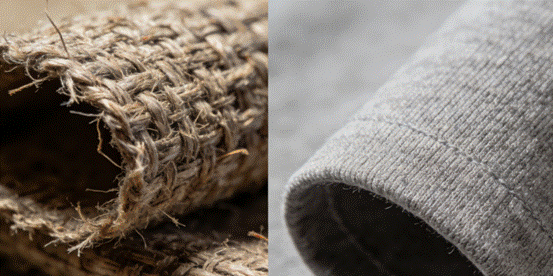
Early FR fabrics were developed primarily for high-risk industrial environments. Fire protection was the dominant requirement, while comfort and aesthetics were secondary considerations.
To achieve flame retardancy, manufacturers relied heavily on post-finishing chemical treatments. These treatments often involved thick coatings or resin-based systems designed to lock flame-retardant chemicals onto the fabric surface. While effective in fire testing, these processes significantly restricted fiber movement, reduced flexibility, and resulted in a stiff, boardy fabric structure.
In addition, many traditional FR fabrics used coarse yarns and dense constructions to compensate for strength loss caused by aggressive chemical finishing. The combined effect was a fabric that performed well in fire tests but felt uncomfortable in daily use.
This historical background explains why many buyers still associate FR fabrics with poor hand-feel—even though textile technology has since advanced.
As FR fabrics expanded beyond heavy industry into automotive interiors, public transportation, hospitality, and architectural textiles, expectations changed.
Fire safety alone was no longer sufficient. Buyers and end users began to demand materials that feel comfortable during prolonged contact, drape naturally like conventional textiles, maintain performance after repeated washing, and integrate safety without sacrificing aesthetics.
This shift forced manufacturers to rethink FR fabric development from the fiber level upward, rather than relying solely on surface-applied solutions.
The most important breakthrough in soft FR fabrics has been the adoption of inherent flame resistant fibers.
Unlike traditional post-treated fabrics, inherent FR fibers possess flame resistance at the polymer level. This means the fiber itself does not burn easily, eliminating the need for heavy surface coatings that cause stiffness.
Modern inherent FR polyester, modacrylic blends, and engineered FR fiber combinations retain flexibility and elasticity, allowing fabrics to move naturally. When blended with natural fibers such as cotton or viscose, these materials can achieve a familiar, textile-like touch while maintaining stable flame-retardant performance.
The table below illustrates how different FR approaches affect hand-feel and long-term usability.
| FR Technology Approach | Flame Resistance Method | Impact on Hand-Feel |
| Traditional post-treated cotton | Surface chemical coating | Often stiff, wash-dependent |
| Inherent FR polyester | Polymer-level FR | Soft, stable, durable |
| FR fiber blends | Fiber + structure engineering | Balanced comfort and safety |
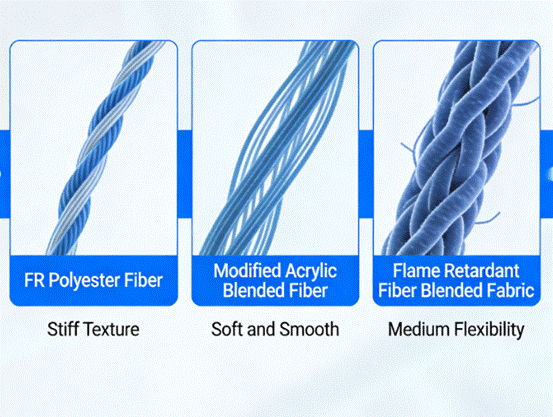
In essence, lasting softness begins at the fiber level. Without the right fibers, finishing alone cannot deliver long-term comfort.
Fiber choice sets the foundation, but yarn construction and fabric design determine how softness is perceived in the hand.
Modern soft FR fabrics use finer yarn counts, uniform fiber distribution, and carefully controlled twist levels. These parameters reduce surface roughness and improve flexibility. Compared to older open-end yarns, ring-spun or engineered blended yarns produce a smoother surface and better drape.
Fabric structure also plays a critical role. Twill and satin constructions naturally create smoother surfaces and softer folds than rigid plain weaves. By optimizing fabric density, manufacturers can maintain strength and durability while allowing the fabric to remain flexible and breathable.
The result is an FR fabric that behaves like a conventional textile—only safer.
Finishing is where modern FR fabrics gain their final tactile character. Unlike older resin-heavy systems, today’s finishing technologies focus on low add-on chemistry and mechanical enhancement.
Typical finishing strategies include:
These processes improve surface smoothness, flexibility, and drape without masking the fabric with a plastic-like coating.
Overall, finishing today enhances what is already engineered into the fabric, rather than compensating for structural limitations.
A common concern among buyers is whether soft FR fabrics are less durable. In modern textile engineering, this trade-off has largely been eliminated.
Through balanced fiber blending, controlled yarn construction, and optimized finishing, soft FR fabrics can retain stable flame-retardant performance, consistent hand-feel after repeated laundering, and good abrasion resistance.
Some advanced inherent FR fabrics developed by BEGOODTEX are designed to deliver soft hand-feel, long-term durability, and certified fire resistance at the same time, making them suitable for both industrial and people-facing environments.
Soft hand-feel FR fabrics are especially valuable in applications where materials are in frequent contact with people or play a visible role in interior design. In these scenarios, comfort and aesthetics directly influence user acceptance and perceived quality.
Different application environments place different emphasis on hand-feel, drape, durability, and appearance, as shown below.
| Application Scenario | Why Soft Hand-Feel Matters | Key FR Fabric Performance Focus |
| Automotive interiors | Frequent human contact, visible surfaces | Soft touch, low noise, abrasion resistance |
| Public & industrial curtains | Large fabric surfaces, frequent movement | Good drape, flexibility, visual uniformity |
| Protective workwear | Long wearing time | Skin comfort, breathability, wash durability |
| Hospitality & public spaces | Design-driven environments | Aesthetic texture, textile-like appearance |
| Transportation interiors | Enclosed spaces, safety-critical | Comfort combined with certified FR performance |
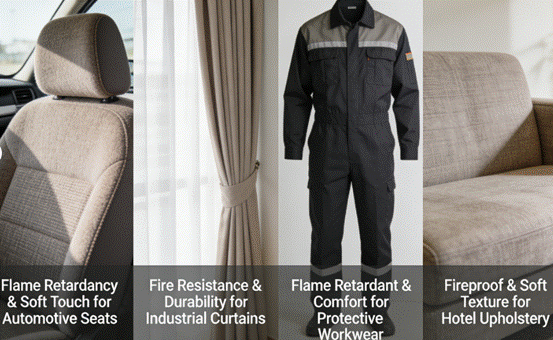
Soft hand-feel is not a cosmetic upgrade. It directly affects usability, comfort, and the suitability of FR fabrics in modern, people-centered applications.
Soft hand-feel is not a single measurable parameter. It is the combined result of surface smoothness, flexibility, drape, and skin-contact comfort.
A well-designed FR fabric should feel smooth rather than coated, drape naturally instead of holding rigid folds, and remain comfortable during extended use. Achieving this experience requires coordinated design across fiber, yarn, fabric, and finishing stages.
Today, the question is no longer whether FR fabrics can be soft.
The real question is whether they should be anything else.
As fire resistant textiles continue to enter design-sensitive and comfort-driven environments, aesthetics and hand-feel are becoming baseline requirements. Modern FR fabrics are expected to look and feel like normal textiles—with fire safety seamlessly built in.
A:Yes. When flame resistance is achieved through inherent fibers or durable low-add-on finishing systems, softness does not compromise fire performance. Modern FR fabrics are engineered to balance both.
A: Yes. Many soft FR fabrics are designed to combine comfort with abrasion resistance, wash durability, and long service life, making them suitable for industrial, commercial, and public-space use.
A: Beyond certifications, buyers should assess fiber composition, fabric construction, finishing quality, and wash durability. Physical samples remain the most reliable way to evaluate real hand-feel.