Enter your details and we will send the requested document to your inbox.





Every year, household fires start from the smallest triggers — a forgotten candle, a faulty charger, a stove left on. Curtains hang closest to windows, outlets, and heaters, and ordinary fabric ignites fast and spreads faster. Fire retardant curtains are built to change that equation. They resist ignition, slow flame spread, and give you and your family the extra minutes that matter most during an evacuation.
If you are weighing whether treated or inherently flame-resistant drapery is worth it, this guide walks through how fire retardant curtains work, which standards prove they are safe, how to choose them room by room, and how to keep that protection working for years.
Quick answer: Fire retardant curtains are a safe, practical choice for home use. Made from inherently flame-retardant (IFR) polyester or certified treated fabrics, they resist ignition and slow flame spread to buy valuable escape time during a fire. They meet NFPA 701 and EN13501-1, and keep protecting through repeat washing when specified as durable.
Fire-resistant curtains play a quiet but critical role in home safety. They act as a barrier that contains flames and resists ignition, made from fabrics engineered to be completely flame retardant rather than ordinary cloth that merely tolerates heat.
The difference shows up at the worst possible moment. When a fire starts, untreated cotton or polyester curtains can become a vertical fuel source, carrying flames up the wall and into the ceiling within seconds. A certified fire retardant curtain does the opposite: it resists catching, and if it does ignite, it self-extinguishes once the source is removed. That delay is not a detail — it is the gap between a small incident and a house fire.
For families, this matters most in rooms where soft furnishings concentrate: living rooms with heaters, kitchens with stoves, and bedrooms where people sleep through the early stages of a fire. Choosing certified drapery is one of the lowest-effort, highest-impact safety upgrades a homeowner can make.

Not every “fire resistant” label means the same thing. Three standards define what a safe curtain actually proves, and they are the first thing any buyer should check.
| Standard | Region | What It Proves |
| NFPA 701 | North America | Fabric passes certified flame-response testing for draperies and decorations |
| EN13501-1 | Europe | Building materials classified by fire reaction behavior (A to F rating) |
| EN13773 Class 1 | Europe | Curtains and drapes rated by burning characteristics; Class 1 is the best |
The NFPA 701 standard describes the methods for testing how fabrics and films respond to fire, ensuring that fire-resistant curtains in North America meet recognized safety requirements. It is the benchmark most U.S. buyers and inspectors look for. You can read the official testing scope from the National Fire Protection Association.
In Europe, EN13501-1 classifies building materials based on their fire reaction behavior. It helps consumers understand the true safety level of fire retardant curtains when comparing products, moving beyond marketing language to a graded result.
EN13773 Class 1 focuses on fabrics used in curtains and drapes, organizing them by burning characteristics. Class 1 means the material performed best in that classification. Note that “disposable” flame retardant textiles — fabrics treated with chemicals during dyeing and finishing — can lose protective qualities over time, which is why the next section matters.
Full reference on these and other regional rules lives on our textile standards page.
Every room asks something different from its curtains. Light, noise, cleanability, and privacy each pull the choice in a different direction — but safety should stay non-negotiable in all of them.
| Room | What Matters Most | Recommended Curtain |
| Living Room | Light transmission + safety | FR sheer or dimout curtain |
| Bedroom | Light blocking + quiet | FR blackout curtain |
| Kitchen | Easy cleaning | Durable FR treated curtain |
Living rooms want plenty of daylight and a cozy feel at once. Choose fire-resistant curtains that let the right amount of sunlight in while keeping safety standards high. Many rely on flame-retardant polyester for curtain linings and furniture, striking a balance between safety and style without sacrificing the beauty of natural light. Our inherently flame retardant polyester range keeps protection built into the fiber, not just coated on.
 Flame Retardant Voile Polyester Fabric Rod Pocket Window Treatment Transparent Sheer Curtains | 84''L × 52''W / 95''L × 52''W | BS 5867 Type C
 Inherent Flame Retardant Polyester Sheer Voile Window Curtain Grommet Bedroom Living Room | 84''L × 52''W / 95''L × 52''W | BS 5867 Type C
 Flame Resistant Polyester Sheer Curtains in Off-White for Bulk Orders and Contract Projects | 95''L × 52''W | BS 5867 Type C
Bedrooms need a private, restful space. Light-blocking curtains and sound-dampening drapery are top choices to improve sleep quality while meeting fire safety requirements. For a blackout option that also carries certified FR performance, our blackout curtain fabric is built for both.
 Short Dimout Curtain with Blackout Performance and Flame Retardant Protection for Custom Production with Bulk Order Support | BS 5867 Type C
 Blue Polyester Blackout Curtain with 95% Light Blocking and Flame Retardant Protection from a China Textile Manufacturer | BS 5867 Type C
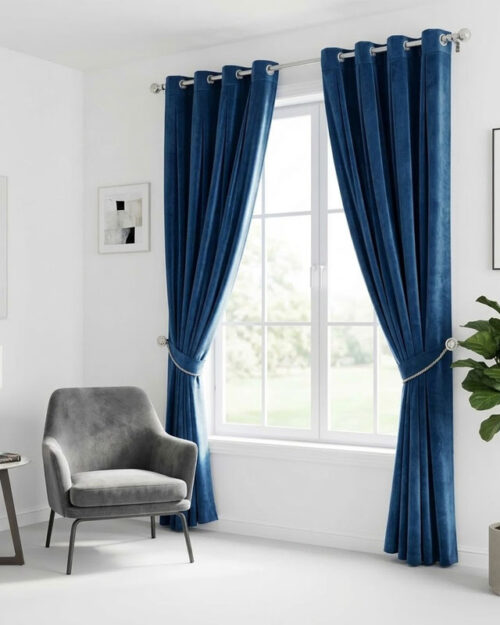 Hotel Velvet Blackout Curtains with Grommets and Inherent Flame Retardancy for Wholesale and Custom Textile Production | BS 5867 Type C
Kitchens and bathrooms face frequent spills, grease, moisture, and repeated cleaning, so cleanability and durability are key considerations. Choose fabrics that can withstand regular washing without losing their flame-retardant performance. Durable flame retardant (DFR) treatments are a preferred option for these high-maintenance areas, as they maintain protection through more wash cycles than disposable treatments.
 Blue Double-Layer Polyester Blackout Door Curtain with Flame Retardant Protection for Made-to-Order Supply | 82 × 55 in | BS 5867 Type C
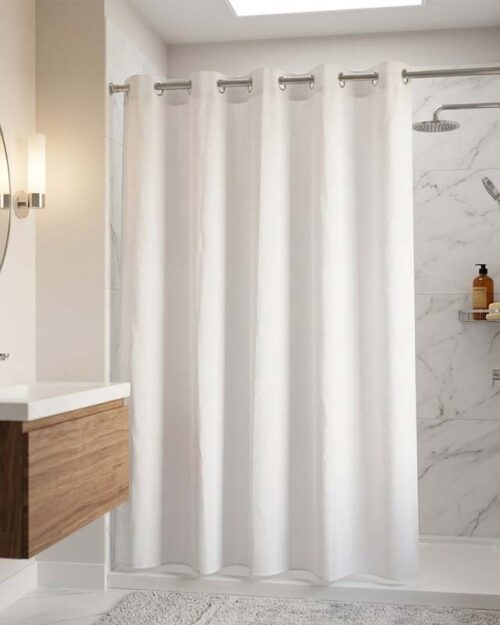 Waterproof Fireproof Shower Curtain Mildew Resistant Polyester for Global Project Supply | Custom Sizes | BS 5867 Type C,ISO 4920
 Flame Retardant Polyester Mesh Top Shower Curtain with Antibacterial Protection for Global Project Supply | BS 5867 Type C,ASTM E2149
A fire retardant curtain only stays safe if you care for it the right way. The goal is simple: keep the flame-resistant treatment intact while removing dust and stains.
Hand washing or a delicate machine cycle with mild detergent protects the fabric and preserves its flame-retardant capability. Avoid aggressive scrubbing that can wear the treatment layer.
Bleach and strong solvents can degrade the flame retardant treatment on the fabric. Stick to cleaning products designed for delicate fabrics so the fire resistance stays intact cycle after cycle.
High heat from dryers can shrink fabric and weaken protective finishes. Air dry curtains in a ventilated area to retain both their shape and their protective properties.
You can find a wide range of fire retardant curtains at BEGOODTEX that combine safety with style, meeting international standards while fitting real interior designs.
Our inherently flame retardant curtains are crafted from 100% flame-retardant polyester, with the fire-resistant property built into the fiber itself rather than applied as a surface coating. This approach boosts longevity and keeps effectiveness intact through many wash cycles — exactly what disposable treatments cannot promise.
The GRS (Global Recycled Standard) certification confirms that BEGOODTEX items meet social and environmental guidelines through manufacturing. It assures customers of the sustainability and ethical practices behind these flame retardant draperies. Independent verification, including TÜV SÜD third-party test reports, backs every claim.
Safety comes first, but never at the cost of style. We offer fire retardant curtains in a variety of fashionable designs and colors so homeowners can upgrade decor while meeting safety requirements. That combination of function and look is why these curtains have become a favored choice for households and contract projects alike.

Yes. Fire retardant curtains are designed specifically to resist ignition and slow flame spread, giving occupants more time to escape during a fire. When made from inherently flame-retardant polyester or certified durable treatments, and verified against NFPA 701 or EN13501-1, they are a safe, code-aligned choice for any room.
Polyester is not naturally fire-resistant — untreated polyester can catch and burn quickly. It becomes fire resistant only through treatment or by being spun from inherently flame-retardant fibers. To ensure 100% polyester curtains actually resist fire, they must go through a proper process that integrates flame-retardant substances into the fiber, which is exactly how IFR polyester curtains are made.
Look for tags or certifications stating compliance with safety standards such as NFPA 701 or EN13501-1. Manufacturers should label items as “fire retardant” or “flame resistant” against established criteria. You can also request the specific flame treatment and test documentation from the supplier or manufacturer. Remember that disposable treated textiles may lose effectiveness after repeated washing.
Quality inherently flame-retardant (IFR) polyester curtains are odor-neutral because the protection is part of the fiber, not a topical chemical. Treated curtains may carry a faint finish smell when new, which typically dissipates after the first gentle wash. Avoid products with no certification, since uncertified treatments are where off-gassing concerns actually appear.
Use a delicate cycle or hand wash with mild detergent, skip bleach and strong solvents, and air dry instead of machine drying. For treated curtains, choose durable (DFR) treatments rated for your wash frequency, and re-check certification if the curtain is years old or heavily laundered.
Fire retardant curtains are one of the simplest, most effective safety upgrades for a home. They resist ignition, slow flame spread, and buy critical evacuation time — across living rooms, bedrooms, and kitchens alike.
When choosing, keep three things in mind:
Explore our full range of fire retardant curtains, from FR sheer to blackout and jacquard options. For project pricing or custom specifications, contact our FR fabric specialists.


