Enter your details and we will send the requested document to your inbox.





In the past, interior textile projects often focused on appearance, price, and fire test results.
Now buyers are asking more questions.
Hotels, office buildings, schools, hospitals, transport hubs, and public building projects are paying closer attention to recycled content, environmental documents, chemical safety, and flame-retardant testing.
Why the change?
Because building interiors use a large amount of textile materials. Curtains, blinds, upholstered panels, acoustic fabrics, seating fabrics, and decorative textiles all play a role in the final space.
These materials need to meet fire safety requirements. At the same time, they may also affect sustainability documentation, project procurement files, and the brand image of the building.

Recycled flame-retardant fabric usually refers to a functional fabric made with recycled fibers while also offering flame-retardant performance.
One common direction is recycled polyester flame-retardant fabric.
Depending on the project, other functions may also be added, such as blackout, antibacterial, water-repellent, antistatic, acoustic, or abrasion-resistant performance.
But two ideas need to be separated clearly.
Recycled refers to the fiber source. For example, yarn may be made from recycled bottle flakes or recycled polyester materials.
Flame-retardant refers to how the fabric behaves when exposed to flame or heat.
They are not the same thing.
A fabric made with recycled fibers is not naturally flame-retardant.
In the same way, a fabric that passes a flame-retardant test is not automatically an eco-friendly material.
For building projects, a suitable recycled flame-retardant fabric should be checked from several sides: recycled content, flame-retardant performance, chemical safety, and final application.
Building projects usually have more than one requirement for fabrics.
In public spaces, fire safety comes first. Curtains, upholstered panels, acoustic fabrics, seating fabrics, and other interior textiles often need to meet relevant fire standards.
But today, owners, design firms, and contractors also care more about sustainable materials, chemical safety, and supply chain documents.
This is why recycled flame-retardant fabric is being mentioned in more projects.
It responds to both needs.
It needs flame-retardant performance. It also needs documents for recycled content, environmental claims, chemical safety, and long-term durability.
From a real purchasing point of view, when customers ask for “recycled flame-retardant fabric,” they are usually not asking for an environmental story only.
What do they really need?
A material that can meet the design effect, fire requirement, sustainability review, and project documentation at the same time.
In architecture and public spaces, recycled flame-retardant fabrics are commonly used in the following applications.
| Application Area | Common Products | What Buyers Should Check |
|---|---|---|
| Hotels and commercial spaces | Curtains, blackout curtains, sofa fabrics, decorative fabrics | Flame-retardant standard, blackout effect, hand feel, drape, color fastness |
| Office buildings and public buildings | Acoustic fabrics, wall upholstered panels, partition fabrics | Fire rating, acoustic structure, abrasion resistance, environmental documents |
| Schools and hospitals | Curtains, cubicle curtains, soft furnishing fabrics | Flame resistance, antibacterial performance, easy cleaning, chemical safety |
| Transport spaces | Seating fabrics, interior fabrics, upholstered materials | Flame resistance, abrasion resistance, smoke density, durability |
| Green building projects | Interior textile decorative materials | Recycled content proof, GRS, OEKO-TEX, REACH, and related documents |
Different applications do not have the same requirements.
So buyers should not judge a fabric only by the words “recycled flame-retardant.”
The final use still comes first.
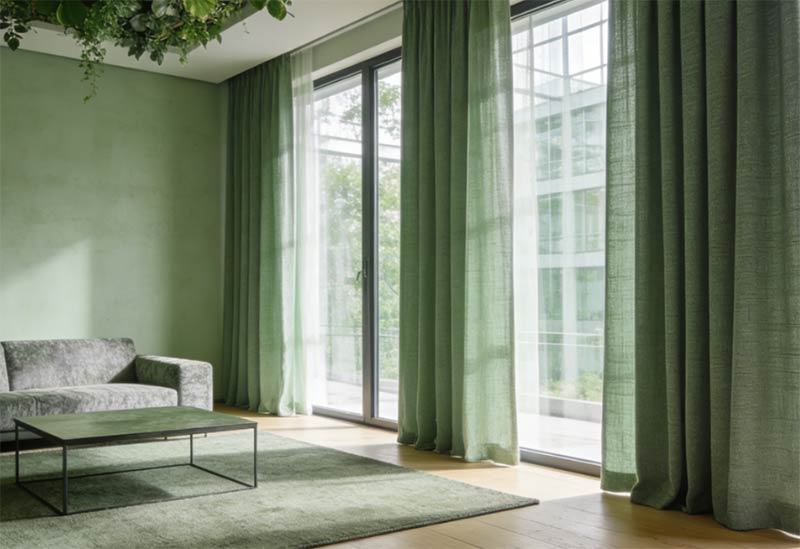
Recycled flame-retardant fabric can support green building projects.
But it should not be described as “green building certified” just because it uses recycled content.
Its role is more about material selection and document support.
For LEED or other green building projects, designers and buyers may review material sources, recycled content, low-emission performance, chemical safety, traceability, and supply chain documents.
If a fabric uses recycled fibers and can provide recycled content proof, flame-retardant test reports, and chemical safety documents, it is easier to support project review and documentation.
But one point must be clear:
Sustainability cannot replace fire safety.
Recycled content cannot replace flame-retardant testing.
In the end, the fabric still needs to meet the fire standard required by its actual application.
Recycled flame-retardant fabrics usually involve two types of documents.
One type is for fire performance.
The other is for environmental and chemical safety.
These documents cannot replace each other.
| Document Type | Common Content | Notes |
|---|---|---|
| Fire testing | EN 13501-1, NFPA 701, BS 5867, DIN 4102, FMVSS 302, etc. | The exact standard depends on the application and target market. |
| Recycled content proof | GRS, RCS, or related supply chain documents | Used to prove the source and content of recycled materials. |
| Chemical safety documents | OEKO-TEX, REACH, PFAS-free, low VOC, or other tests | Used to evaluate harmful substances and indoor-use safety. |
| Durability tests | Color fastness, abrasion resistance, wash stability, dimensional stability | Related to long-term use and bulk project performance. |
So before purchasing, buyers should confirm the application first, then confirm the standard.
Do not mix reports from different markets or different uses.
A curtain report may not cover seating fabric.
A recycled content certificate may not prove fire performance.
A fire test report may not prove chemical safety.
One common mistake is mixing “recycled,” “eco-friendly,” and “flame-retardant” together.
They are related, but they are not the same.
Having recycled content does not mean the fabric is suitable for public buildings.
Fire testing, chemical safety, color fastness, abrasion resistance, and bulk stability all need to be checked separately.
Documents such as GRS, OEKO-TEX, and REACH are important.
But they cannot replace a fire test report.
Can the fabric be used for curtains, upholstered panels, acoustic fabrics, or seating materials?
That still depends on the flame-retardant test required for the actual application.
Another mistake is looking only at the sample.
Building projects usually need large quantities. Recycled yarn, dyeing, finishing, and functional treatment can all affect bulk consistency.
If there is obvious shade difference, unstable hand feel, or inconsistent flame-retardant performance in bulk production, the later project work can become difficult.
Finishing also needs special attention.
Blackout coating, water-repellent finishing, antibacterial treatment, printing, lamination, and backing can all affect flame-retardant performance, odor, hand feel, and environmental test results.
So when checking reports, buyers should look carefully.
Does the report cover the base fabric only?
Or does it cover the final finished fabric with coating, backing, or other treatments?
This difference matters in real project approval.

Recycled flame-retardant fabric is becoming more important in architecture and public-space projects because customers now need both fire safety and more sustainable material options.
But buyers should not rely on one label only.
Recycled fiber does not equal flame resistance.
A flame-retardant test does not equal environmental certification.
A good-looking sample does not guarantee stable bulk production.
Environmental claims can support the material story, but final decisions still depend on real test documents and project requirements.
For hotels, hospitals, schools, office buildings, transport spaces, and green building projects, buyers should confirm several points before ordering.
Where will the fabric be used?
Which fire standard is required?
Is there proof of recycled content?
Are chemical safety documents complete?
Does the test report cover the final finishing?
Can bulk production remain stable?
Only when these details match can recycled flame-retardant fabric become more than an environmental concept.
It becomes a practical material solution that can support real project delivery.
Recycled flame-retardant fabric usually refers to a functional fabric made with recycled fibers and flame-retardant performance.
Common examples include recycled polyester FR fabric, recycled FR curtain fabric, and recycled FR upholstery fabric.
No.
Recycled only describes the fiber source.
Flame-retardant performance depends on whether the fabric has passed the required fire test.
The two should not be confused.
Yes, it can be suitable for many architecture and public-space projects, such as curtains, blackout curtains, acoustic fabrics, wall panels, seating fabrics, and decorative fabrics.
But the final suitability depends on the application, fire standard, durability, and supporting documents.
Yes, it can be part of a sustainable material selection.
But it cannot decide green building certification by itself.
Recycled content proof, chemical safety documents, fire test reports, and other project-required documents may still be needed.
Do not only look at one label, whether it says “eco-friendly” or “flame-retardant.”
Buyers should confirm the final application, fire standard, recycled content proof, chemical safety documents, finishing scope, and bulk production stability.
