Enter your details and we will send the requested document to your inbox.






Silk is prized for luxury, but how does it perform regarding fire safety? Its flammability is often misunderstood. This natural fiber behaves uniquely when exposed to flame—unlike cotton or polyester. Discover silk's true burn characteristics and why its use is strictly controlled.

Is spandex flammable? Learn how spandex burns, its 18–20% LOI, how flame retardant spandex works, and what buyers should check for protective applications.

Polyester is one of the most widely used synthetic fibers in the world, known for its durability, versatility, and affordability. It is the foundational material for a vast range of products, found in everything from clothing (like shirts and activewear)…

Aramid is more than just a fabric. It exists as high-strength yarn, high-temp pulp, and electrical insulation paper. Understand the complete product classification to source the right material.

Aramid is one of the safest FR fibers (non-toxic, OEKO-TEX® certified). But is it "green"? We explore the paradox of its energy-intensive production vs. its eco-friendly durability.

Aramid isn't just for PPE. Why is it the required material for everything from airline seats to stage curtains? We explore the 4 critical industries that depend on its inherent FR properties.

"Flame retardant" isn't a vague promise; it's a quantifiable metric. Aramid's "no-drip" (d0) and "low-smoke" (s1) properties make it a benchmark material for passing the world's toughest FR tests. Here’s why it complies.

Compare aramid and FR cotton for heat resistance, comfort, cost and arc-flash protection.

Both are high-performance Aramids, but one stops fire while the other stops bullets. Why are their applications so different? We dive into the molecular structure to reveal the answer.

The core reason aramid (Aramid) does not burn lies in its unique “Inherent Flame Resistant” (IFR) property. This originates from the aromatic ring structure in its molecular backbone, which has extremely high bond energy. This rigid structure is exceptionally stable at high…

Aramid fabric guide: Kevlar vs Nomex, strength, heat resistance and uses in protective gear.

Nylon fabric is favored for its durability and versatility, but when it comes to fire safety, it hides a critical question. Is it flammable or safe? The answer is far more complex than a simple “yes” or “no.” It involves…
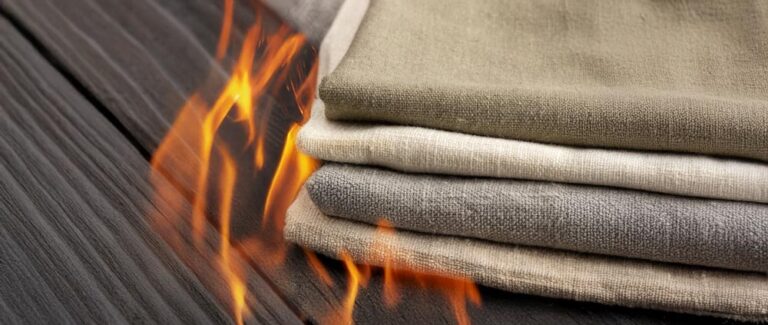
The Flammability of Linen Is Linen Flammable? Yes, linen is classified as a flammable textile. It is a natural plant fiber, and like other plant-derived fibers (such as cotton), it has a relatively low ignition point. Once linen comes into contact…

In our daily lives, cotton is everywhere—from soft T-shirts, comfortable bed sheets to absorbent towels. As a natural fiber, cotton is favored for its comfort and breathability. But when it comes to fire safety, a key question emerges: Is cotton…

Learn how to prevent fire at home with practical tips for cooking, heaters, electrical safety, smoke alarms, escape plans, and flame-retardant fabrics.
Focused on flame retardant textile development since 2013.
Supports fabric development, sample testing and internal performance checks.
Product-specific test reports available for different markets and applications.
Samples, customization, confirmed specifications and bulk production support.
